DLS / DLS-C Series
45
Cod.: 240.010.0042
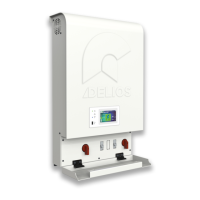
3.3 LV Lithium Battery
The DLS hybrid inverter uses a low voltage lithium storage battery (LV) to store the energy from the PV
panels and optimize self-consumption.
The DLS hybrid inverter can operate with various low voltage (LV) batteries which have been specically
tested and approved by DELIOS s.r.l. to ensure the safety and optimal operation of the system.
WARNING: Connect only the battery models approved by DELIOS s.r.l. to the DLS hybrid inverter Contact
the DELIOS s.r.l. or consult the website www.delios-srl.it to identify the supported batteries.
3.3.1 Calibration Charge
Based on the state of health of the battery and to get an accurate and reliable state of charge (SOC) indica-
tion, the control module integrated in the battery (BMS) cyclically requests the DLS hybrid inverter to carry
out a calibration charge up to 100%. This allows you to make the best use of the battery and maximize the
useful life of the internal cells.
The calibration charge is primarily carried out by means of the energy from the solar panels which is entirely
destined for the purpose. If the energy available from the solar panels is not enogh then the missing part is
drawn from the network.
WARNING: During the calibration charge, normal system functionalities are disabled, and the battery can-
not be used by the system. They are automatically restored at the end of the calibration process.
WARNING: During the calibration charge the EPS mode is disabled. It is automatically restored at the end
of the calibration process.
WARNING: Calibration charge is required by the battery integrated control module (BMS). The DLS hybrid
inverter cannot in any way disable the command from the battery.
The duration of the calibration charge depends on the energy available from the solar panels and on the
health of the cells of the battery. This process can also take a long time (hours and / or days) especially
during the winter when the available solar energy can be very low.
The calibration charge status is shown on the display status bar.
3.3.2 Maintenance Charge
During the winter period or after long periods of inactivity, the battery may remain at the minimum state of
charge for a long time with the risk of a deep discharge phenomena with consequent risk of structural da-
mage to the internal cells. Therefore, to avoid damages of the battery, the control module integrated in the
battery (BMS) may require the DLS hybrid inverter to carry out a maintenance charge.
The maintenance charge brings the state of charge from the minimum value to a value determined by the
BMS based on the state of health of the cells. The charging current is also determined by the BMS module
based on the health and temperature of the battery itself.
WARNING: The maintenance charge is a safety function of the battery to avoid damages. For this reason,
the DLS hybrid inverter can activate grid charging if the available solar energy is not enough.


 To Next Page