DLS / DLS-C Series
35
Cod.: 240.010.0042
2.2 Dismantling, decommissioning and disposal
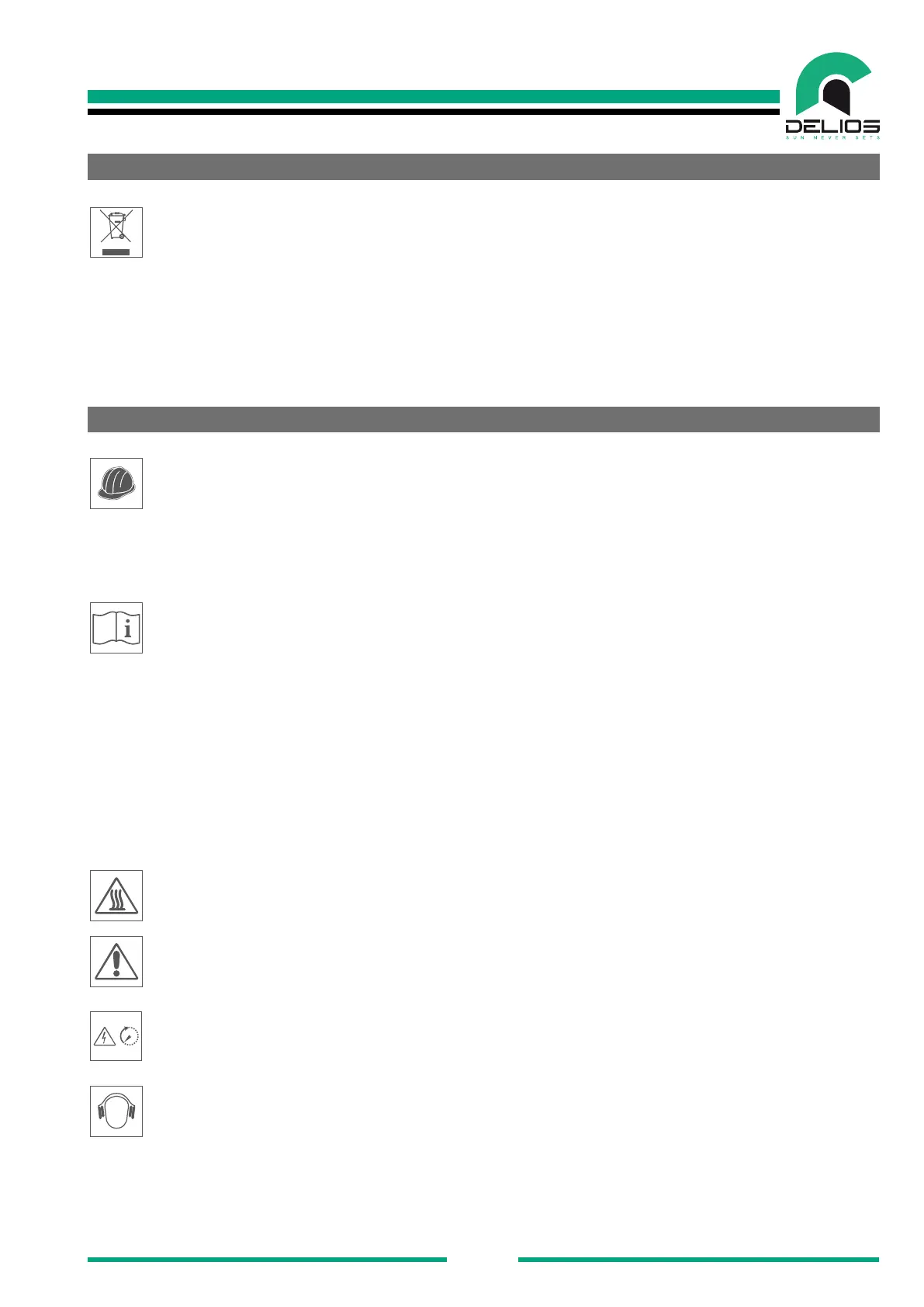
To comply with the 2002/96 / EC European Directive relating to electrical and electronic waste and its im-
plementation as national law, electrical equipment that has reached the end of its useful life and discharged
batteries must be separated from general waste and disposed to the appropriate authorized collection and
recycling centers.
Any device that is no longer needed must therefore be returned to the distributor or disposed to an autho-
rized collection and recycling center in your area. Ignoring this European Directive can have potentially
negative effects on the environment and your health!
2.3 Protecting Staff and Third Parties
The equipment was built according to the strictest safety standards and equipped with safety devices sui-
table for the protection of components and operators.
For obvious reasons, the manufacturer cannot envisage all potential type of installations and locations whe-
re the equipment will be installed; the Customer must therefore clearly inform the manufacturer of specic
conditions of installation. DELIOS s.r.l. declines any responsibility if the DLS system is incorrectly installed
and shall not be liable for other systems located upstream or downstream of the equipment supplied.
• The operators must be correctly informed. The operators must therefore read and follow the technical
instructions contained in the manual and in the enclosed documentation.
• The instructions provided in this manual do not replace the safety regulations and the installation and
operational technical data printed on the products, nor do they replace the current safety standards
enforced in the country where the equipment is installed and the rules dictated by common sense.
• The manufacturer is available to provide the theoretical or practical training to operators, both on their
site or on the customer’s premises, as specied at the time of drawing up the contract.
• The equipment must not be used if any operating fault is identied.
• Temporary repairs should be avoided; repair work must be carried out only with genuine spare parts,
which must be installed according to the intended use.
• The responsibilities deriving from the commercial components are delegated to the respective manu-
facturers.
Avoid touching the inverter enclosure during the equipment operation.
The inverter enclosure could overheat during its operation and cause burns by contact.
Guards or covers can be removed only 10 minutes after disconnecting the inverter from the power supply
to allow its components to cool down and any static electricity storage devices to discharge.
As soon as it is switched off, the surface of the equipment could be hot, therefore great care must be taken.
In the event of re, CO2 foam extinguishers must be used and selfvacuum systems must be used to put out
res in enclosed spaces.
Should the noise level exceed legal limits, the working area must be circumscribed and all the people who
have access to the area must wear ear defenders or ear plugs.
The noise level produced by the inverter in normal working conditions is: < 50db.
During the installation process, special attention must be paid to xing the equipment and its components.
During this stage, circumscribing and preventing access to the installation area is recommended.


 To Next Page