87Appendix H: Professional Use Instructions 87
Dexcom G6
®
System • Using Your G6
Appendix H: Professional Use
Instructions
H.1 Introduction
The G6 supports multi-patient use. You just prepare the G6 for your patient, prepare
your patient for the G6, set up the G6 with the patient, and then follow up with them
to share insights on their glucose trends, patterns, and statistics. This helps both of
you manage their diabetes better. The following sections go through each step and
give you resources to share with your patients as you guide them through a sensor
session.
H.2 Prepare G6 for Patient
First, decide whether the patient should be able to see their G6 readings (unblinded).
Will this motivate them to manage their diabetes better?
Whether the G6 receiver is blinded or unblinded, all G6 patients:
• Must carry their receiver so it records their data for later analysis.
• Get system alerts (including: Pair Transmitter, Start Sensor, New Sensor, Signal
Loss, No Readings, Calibration).
The differences between blinded and unblinded are:
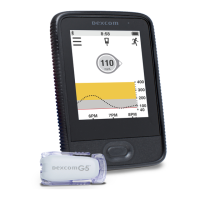
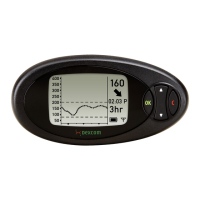
• Unblinded: Receiver shows patient’s G6 reading, arrow, graph, and all glucose-
related alarm/alerts (that is: Urgent Low Glucose, Urgent Low Soon, Low
Glucose, High Glucose, Rise Rate, or Fall Rate).
• Blinded: Receiver does not show any unblinded information. In addition, it does
not show the Warmup Complete message.
Go to clarity.dexcom.eu for more information (may not be available in all regions).
Follow the instructions to wipe and disinfect the receiver and transmitter between
patients. When using for multiple patients, do not use the optional, soft plastic
receiver case.



 To Next Page