CAUTION: Radiator pressure testing tools are very
sensitive to small air leaks, which will not cause
cooling system problems. A pressure cap that does
not have a history of coolant loss should not be
replaced just because it leaks slowly when tested
with this tool. Add water to tool. Turn tool upside
down and recheck pressure cap to confirm that cap
needs replacement.
COOLANT—LOW LEVEL AERATION
If the coolant level in the radiator drops below the
top of the radiator core tubes, air will enter the sys-
tem.
Low coolant level can cause the thermostat pellet
to be suspended in air instead of coolant. This will
cause the thermostat to open later, which in turn
causes higher coolant temperature. Air trapped in
cooling system also reduces the amount of coolant
circulating in the heater core. This may result in low
heat output.
COOLING SYSTEM—DEAERATION
As the engine operates, any air trapped in cooling
system gathers under the radiator cap. The next time
the engine is operated, thermal expansion of coolant
will push any trapped air past radiator cap into the
coolant reserve/overflow tank. Here it escapes to the
atmosphere into the tank. When the engine cools
down the coolant, it will be drawn from the reserve/
overflow tank into the radiator to replace any
removed air.
SERVICE PROCEDURES
COOLANT—ROUTINE LEVEL CHECK
NOTE: Do not remove radiator cap for routine cool-
ant level inspections. The coolant level can be
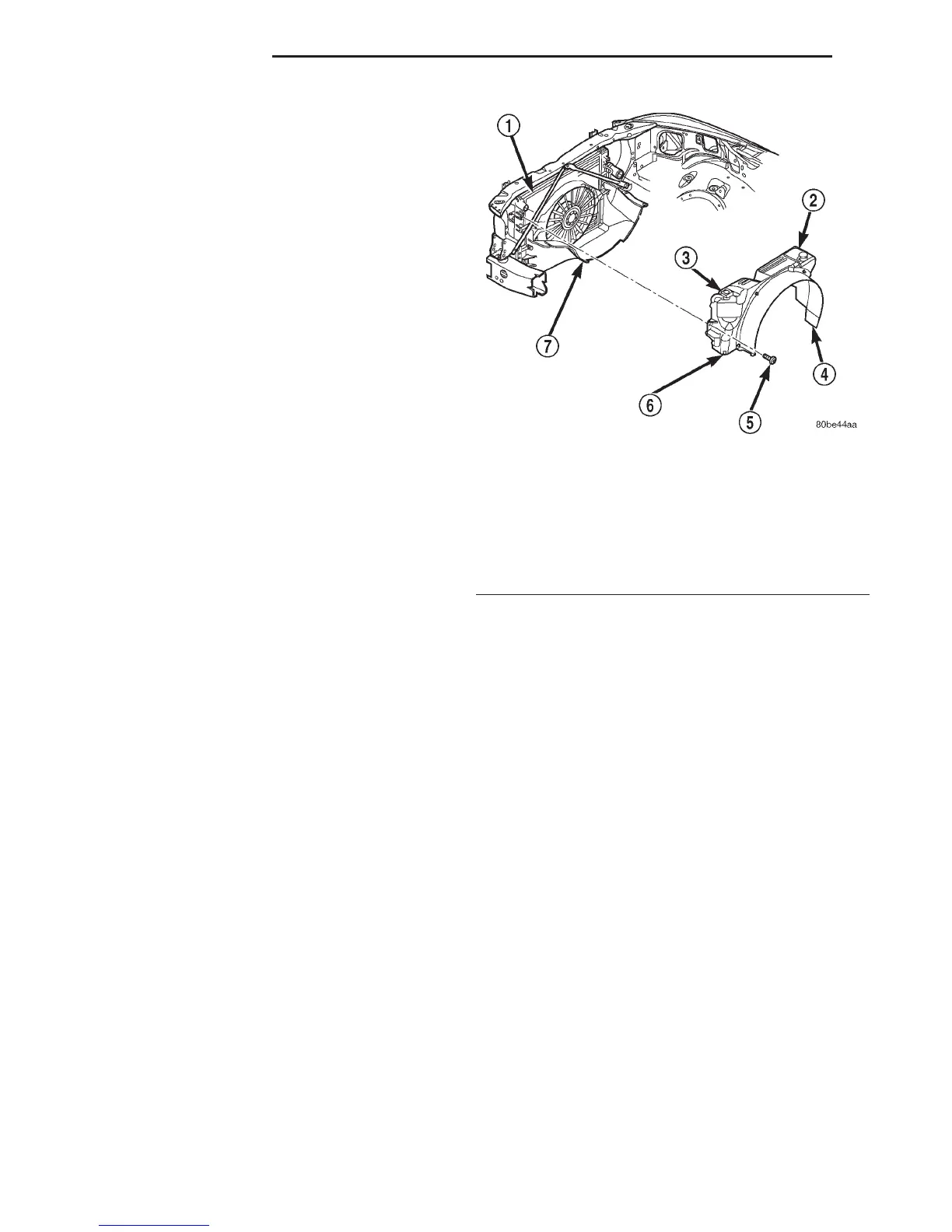
checked at coolant recovery bottle (Fig. 25).
The coolant reserve/overflow system provides a
quick method for determining coolant level without
removing radiator pressure cap. With engine not run-
ning, open the coolant recovery bottle cap and
remove coolant level indicator dipstick to observe
coolant level in coolant recovery bottle. The coolant
level should be between ADD and FULL marks. If
the coolant level is at or below the ADD mark, fill
the recovery bottle with a 50/50 mixture of antifreeze
and water ONE QUART AT A TIME. Repeat this pro-
cedure until the coolant level is at the FULL mark.
COOLANT SERVICE
For cooling system flush and fill maintenance
intervals, refer to Group 0, Lubrication and Mainte-
nance.
COOLANT
DESCRIPTION
ETHYLENE-GLYCOL MIXTURES
CAUTION: Richer antifreeze mixtures cannot be
measured with normal field equipment and can
cause problems associated with 100 percent ethyl-
ene-glycol.
The required ethylene-glycol (antifreeze) and water
mixture depends upon the climate and vehicle oper-
ating conditions. The recommended mixture of 50/50
ethylene-glycol and water will provide protection
against freezing to -37 deg. C (-35 deg. F). The anti-
freeze concentration must always be a minimum of
44 percent, year-round in all climates. If percentage
is lower than 44 percent, engine parts may be
eroded by cavitation, and cooling system com-
ponents may be severely damaged by corrosion.
Maximum protection against freezing is provided
with a 68 percent antifreeze concentration, which
prevents freezing down to -67.7 deg. C (-90 deg. F). A
Fig. 25 Coolant Recovery Bottle Location
1 – RADIATOR
2 – WASHER FLUID RESERVOIR
3 – COOLANT OVERFLOW/RESERVOIR
4 – FAN SHROUD (UPPER)
5 – SCREW
6 – INTERLOCKING PINS
7 – FAN SHROUD (LOWER)
7 - 22 COOLING SYSTEM DN
DIAGNOSIS AND TESTING (Continued)







 To Next Page