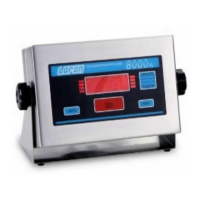
The 7000XL and the 7000 resolve this dilemma by sending a "start bit" at
the beginning of each data byte. This bit tells the printer or computer that
a new data byte is on the way. When the start bit is received, the bit timer
starts running and runs until it has received the correct number of bits.
The number of bits sent is controlled by the data bit and parity setup.
Eight data bits (seven in some cases) usually follow the start bit. After
that, a parity bit is sent, followed by the stop bits. Parity bits are sent to
help detect errors which may have occurred during transmission. In many
cases, parity bits are ignored. The stop bits signal the end of the data and
permit the bit timer a chance to reset its self before the next data byte is
sent. The number of stop bits sent can be as few as one and as many as
two.
Parity bits can take three forms: odd, even or none,. With odd or even
parity, the parity bit is set if the sum of the data bits is odd or even
respectively. Parity bits are useful for detecting data bytes which have
been damaged by noise. When parity is set to none, no parity bit is
added to the bit stream.
In many cases, the receiving device will be a slow printer with limited
memory. In these cases, data may be sent faster than the printer (or
computer) can use. As a result, data may become lost or scrambled. To
prevent this from happening, "Handshaking" is used. When the receiving
unit is busy or incapable of accepting further data, it activates the
handshaking telling the sending unit to stop transmission. Then,
whenever the receiving unit is ready for more data, it deactivates the
handshaking and data transmission continues.
The 7000XL and 7000 offer both hardware and software handshaking.
Hardware handshaking makes use of the CTS (clear to send) input on
the 7000. When this signal is active, the scale is permitted to send data.
When the receiving unit is busy, the CTS line is deactivated and the 7000
stops sending data. When the receiving unit is ready for more data, the
CTS is reactivated and the 7000 will finish sending the data string it was
sending when transmission was interrupted. All readings created while
transmission is halted are discarded.
Software handshaking relies on bi-directional communications to send the
XON (Ctrl-S) and XOFF (Ctrl-Q) flow control characters. The 7000 has
limited bi-directional serial communications to support software
handshaking. When a "Ctrl-Q" is received, the transmission of data is
halted until a "Ctrl-S" is received. To use this mode, the RTX line of the
7000 is tied to the TXD line of the receiving unit.
31


 To Next Page