4 User Manual
Introduction
Principles of Operation
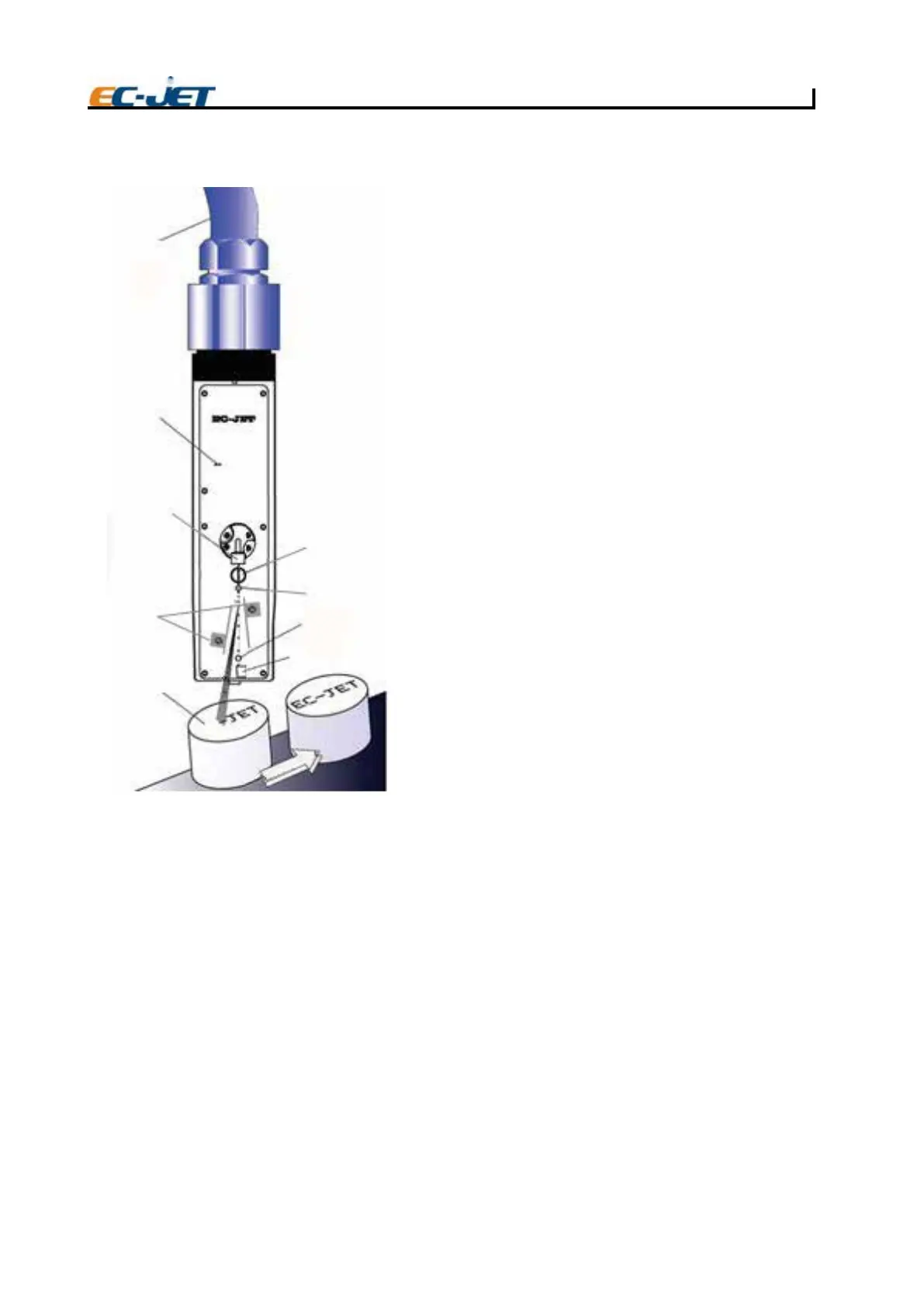
A conducting ink is supplied under pressure to an ink gun and forced
out through a small nozzle of typically 50 to 70 microns in diameter. As
it passes through the nozzle the liquid is piezo-electrically pulsed
(modulated) and the stream breaks up into a continuous series of
drops which are equally spread and are of the same size.
Surrounding the jet at the point where the drops separate from the
liquid stream is a charge electrode. A voltage is applied between the
charge electrode and the drop stream. When the drop breaks off from
the stream it carries a charge proportional to the applied voltage at the
instant at which it breaks off. By varying the charge electrode voltages
at the same rate as the drops are produced, it is possible to charge
every drop to a predetermined level.
The drop stream continues its flight and passes between two deflector
plates which are maintained at a constant potential, typically
plus and
minus 5 kilovolts. In the presence of this field a drop is deflected
towards one of the plates by an amount proportional to the charge
carried. Drops which are uncharged are undeflected and are collected
by a gutter to be recycled into the ink tank. Those drops which are
charged, and, therefore, deflected, are printed on the substrate, which
is travelling at a degrees to the direction of the drop deflection.
By varying the charge on the individual drops, whatever pattern is
required (including alphanumeric characters) may be printed. A series
of drops deflected across the substrate is known as a raster.
EJ04
Conduit to
control unit and
ink system
Temperature
sensor
Chare
electrode
Nozzle
Phase
sensor
Deflector
plates
VOD sensor
Print pattern
being created
Gutter


 To Next Page