-
-
Now you are
oin
to use the operational amplifie
as a comparator and as a Schmitt tri
er circuit. A
ong as
ts
nput vo
tage excee
s a certa
n va
ue, t
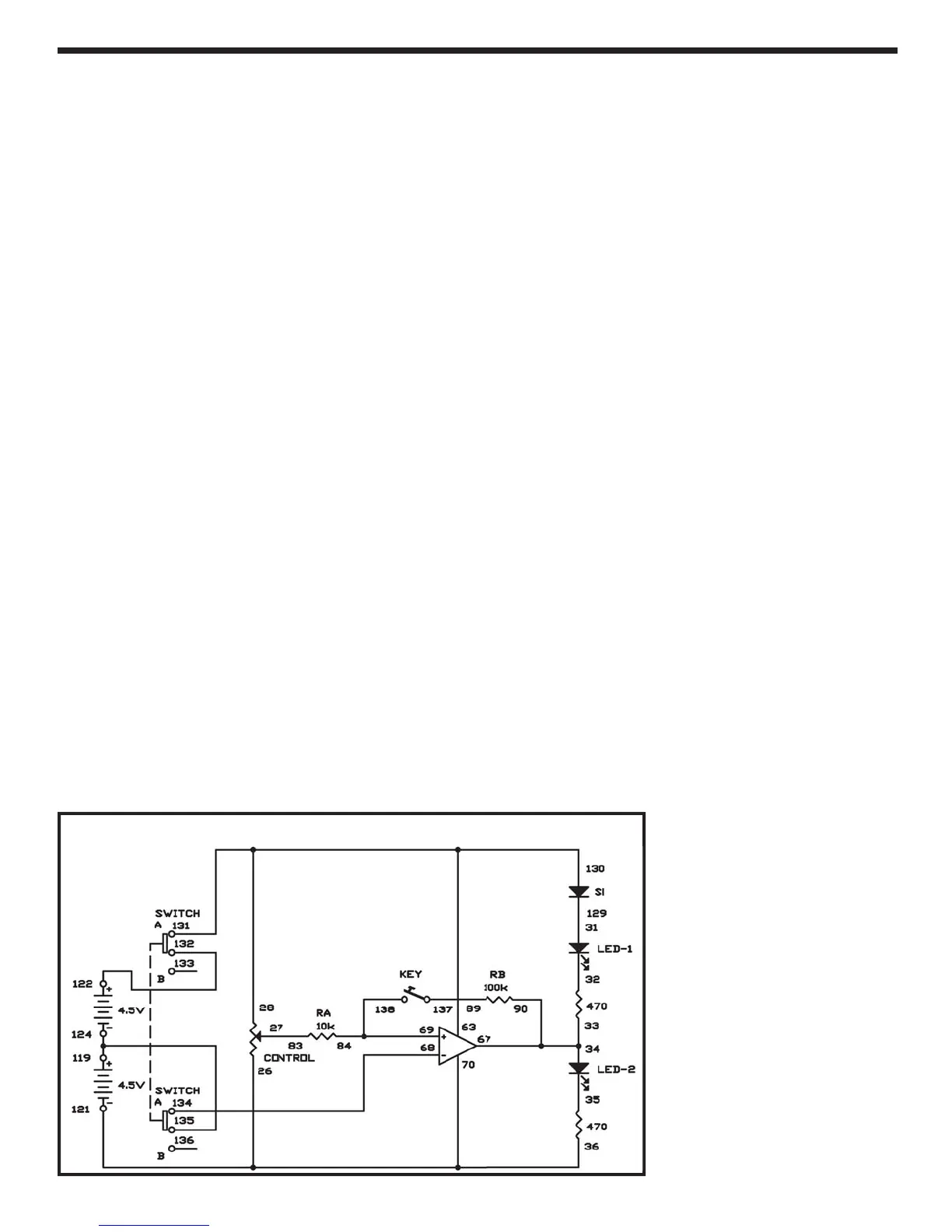
operational amplifier will produce a signal. View th
schematic: can you see how it works? The input
level that turns on the output is higher than the leve
than turns it off. So once a Schmitt tri
er circui
turns on,
t stays on un
ess t
e
nput
rop
signi
icantly. We call this type o
operation
“hysteresis loop.
Build the circuit, but don’t press the key yet. Th
operational ampli
ier serves as a comparator in thi
state. When you alternate the control, LEDs 1 and
take turns li
htin
at some point. Note that this poin
doesn’t alter whether you turn the control clockwis
or counterclockwise.
Now push the key and you have a Schmitt tri
e
c
rcu
t, w
c
ma
es a
ysteres
s
oop.
urn t
e
control and see how the circuit operation is differen
from
for
.
As the ratio of resistors RB
RA increases, the widt
o
hysteresis becomes narrower. Try using di
eren
values for RA and RB
and notice how the widt
chan
es
otes:
EXPERIMENT #
2: INTR
D
IN
THE
HMITT TRI
E
iring Sequence:
7
-
-2
-121
7-
3-28-130-131
-
-
7-
8-134
4-69-138
9-137
19-124-135
22-1
2
1-129
chemati








 To Next Page