-
5
-
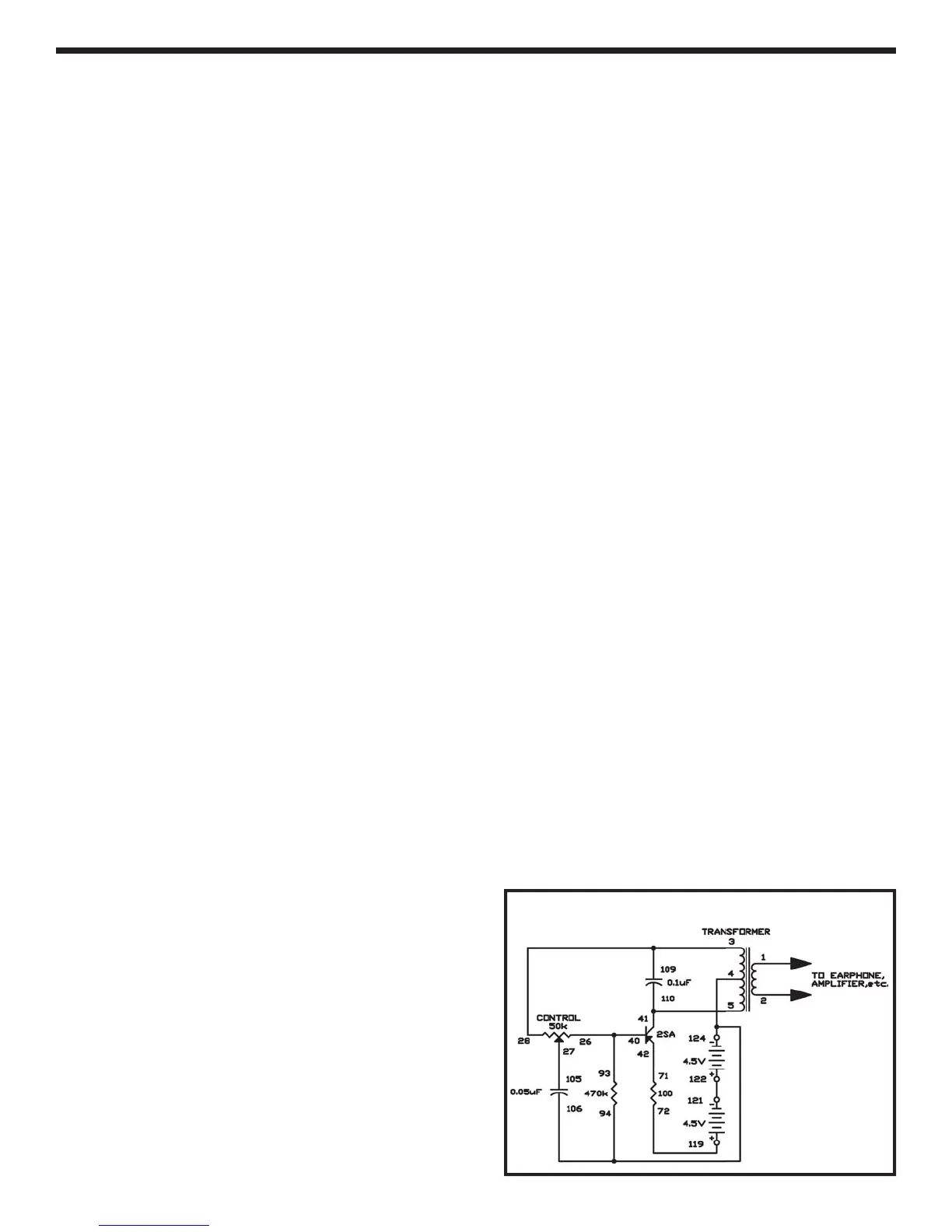
This oscillator circuit produces a sine wave si
nal.
sine wave (or sinusoid) is a wave of pure sin
le
frequency tone. As an example, a 400Hz sine wav
is a wave that oscillates 400 c
cles in one secon
and contains no other frequency contents. Non-sin
waves
such as square wave or triangular wav
si
nals
have harmonics - waves with frequencie
that are multiples o
the sin
le-
requenc
fundamental wave. A non-sine 400Hz wave can
include the 400Hz wave (its fundamental wave)
alon
with an 800Hz wave (its 2nd harmonic wave)
and a 1200Hz wave
its third harmonic wave
.
square wave si
nal contains many harmonics.
xper
ence
tec
n
c
ans can test a c
rcu
t
y putt
n
a s
ne wave
nto
t an
sten
ng to
ts output - an
you can too. I
you put in a sine wave, and somethin
else comes out, the undesired harmonic
re
uencie
ust have been generated somewhere in the circuit.
The ke
parts of this circuit that produce a 400H
s
ne are
0.
capac
tor connecte
across term
na
3 and 5 o
the trans
ormer. This
orms a tan
circuit that resonates at about 600Hz.
•
470
Ω r
i
tor to t
rn on th
o
th
ransistor onl
a little
An ad
ustable
eedback circuit that includes the
contro
an
t
e 0.05
ca
ac
tor.
• A 100Ω resistor connected to the emitter. Thi
e
ps to sta
ze t
e c
rcu
t an
eep t
e soun
rom being distorted
onnect the earphone to terminals 1 and 2 of the
transformer. Start with the control on maximum
10
on the dial
and slowly decrease the control settin
while listening to the tone quality o
the output. Be
or
t
e osc
at
ons stop,
ou w
reac
a po
nt w
ere
ou
ear on
y one tone.
s
ast c
ear-soun
ng tone
t
e s
ne wave.
epeat t
ese contro
a
ustments unt
you
ave no trou
e
st
ngu
s
ng
etween a s
ne
wave and a distorted wave
t
EXPERIMENT #12
:
INE WAVE
ILLAT
Schematic
iring
equence:
-EARPH
N
-EARPH
N
-
-
4-94-106-124
-41-11
-4
-
7-
5
42-71
72-11
21-122





 To Next Page