-
4-
This is the last in the series of microphone amplifiers
Now you will use the operational amplifier as
differential amplifier. It is a two-power source typ
amplifier, and this time we use the speaker as a
micro
hone
Slide the switch to
osition B and construct the
ircuit. When you finish the wiring, apply th
arphone to your ear, slide the switch to position
to turn on the power, and tap the speaker li
htly with
your
in
er.
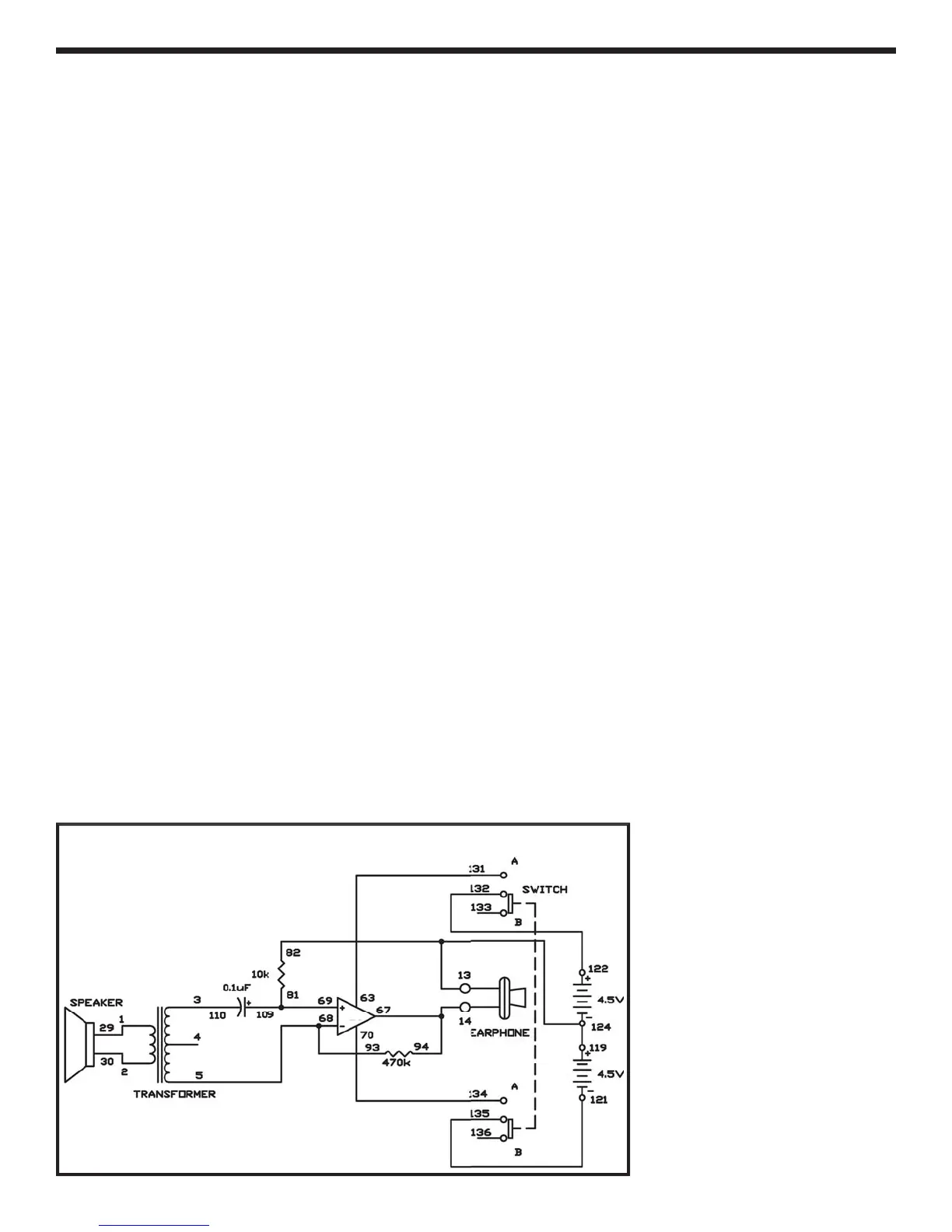
In this circuit the operational ampli
ier is con
i
ure
to amplify the difference between its positive
+
an
ne
ative (–) inputs, so we call it a differentia
ampli
ier. The speaker is connected to th
trans
ormer, which is then connected to th
ampli
ier’s inputs, so the speaker signal will be
am
lified.
In a speaker, an electrical signal
lows through a coil
and creates a magnetic field; the magnetic fiel
hanges as the electrical signal changes. Th
ma
netic
ield is used to move a small ma
net, an
t
s movement creates var
at
ons
n a
r pressure
which travel to
our ears and are interpreted a
o
n
.
This circuit uses the speaker as a microphone. In thi
arran
ement, your voice creates variations in ai
pressure, w
c
move t
e magnet
ns
e t
e
speaker. The moving magnet’s magnetic
ield create
an electrical signal across both ends of a coil. Thi
small signal is applied to the primary o
th
trans
ormer, which then results in lar
er si
nal at th
secondary side o
the trans
ormer
his circuit is simplified by using the speaker as
microphone. To use the earphone as in previou
xperiments, you would have to make a far mor
omp
ex c
rcu
t.
t
:
EXPERIMENT #7
: D
AL-
PPLY DIFFERENTIAL AMPLIFIER
Wiring Sequence:
-2
-
3-110
-
-
3-131
9-81-109
70-134
21-135
-
24-119-82-13-EARPH
NE
4-
7-14-EARPH
NE
Schematic




 To Next Page