-
In Projects 72 and 73 (“Non-invertin
Dual
uppl
Op Amp,” and “Invertin
Dual Supply Op Amp,”
respectively
, we used the operational amplifier wit
two power sources.
n t
s exper
ment, we w
ma
a sin
le-power source, non-invertin
microphone
amplifier. A
ain, the earphone works as
m
crop
one
lide the switch to position B and assemble the
ircuit. When you competed the wirin
, slide th
witch to
osition A to turn on the
ower, alternat
the control clockwise, and speak into th
m
crop
one.
e exper
ment wor
s
ust
e
ro
ect
72 and 73, but you’ll notice somethin
different.
The contrast comes
rom the gain o
this microphon
ampli
ier. It is still determined by R1 and R2, but now
it’s much bigger.
an you observe why? Yes, we us
the 1
resistor in
lace of the 1
resistor from
t
e
ast two exper
ments.
ry c
ang
ng
2 to 1
and the
ain drops to the level o
the las
exper
ments
n t
s ex
er
ment, two
ower sources are connecte
in series to operate the dual operational ampli
ier a
9V. But the operational ampli
ier can work at hal
thi
voltage, at 4.5V.
ee what occurs when yo
disconnect the operational ampli
ier
rom batter
terminal 122 and connect it to terminal 11
.
t
:
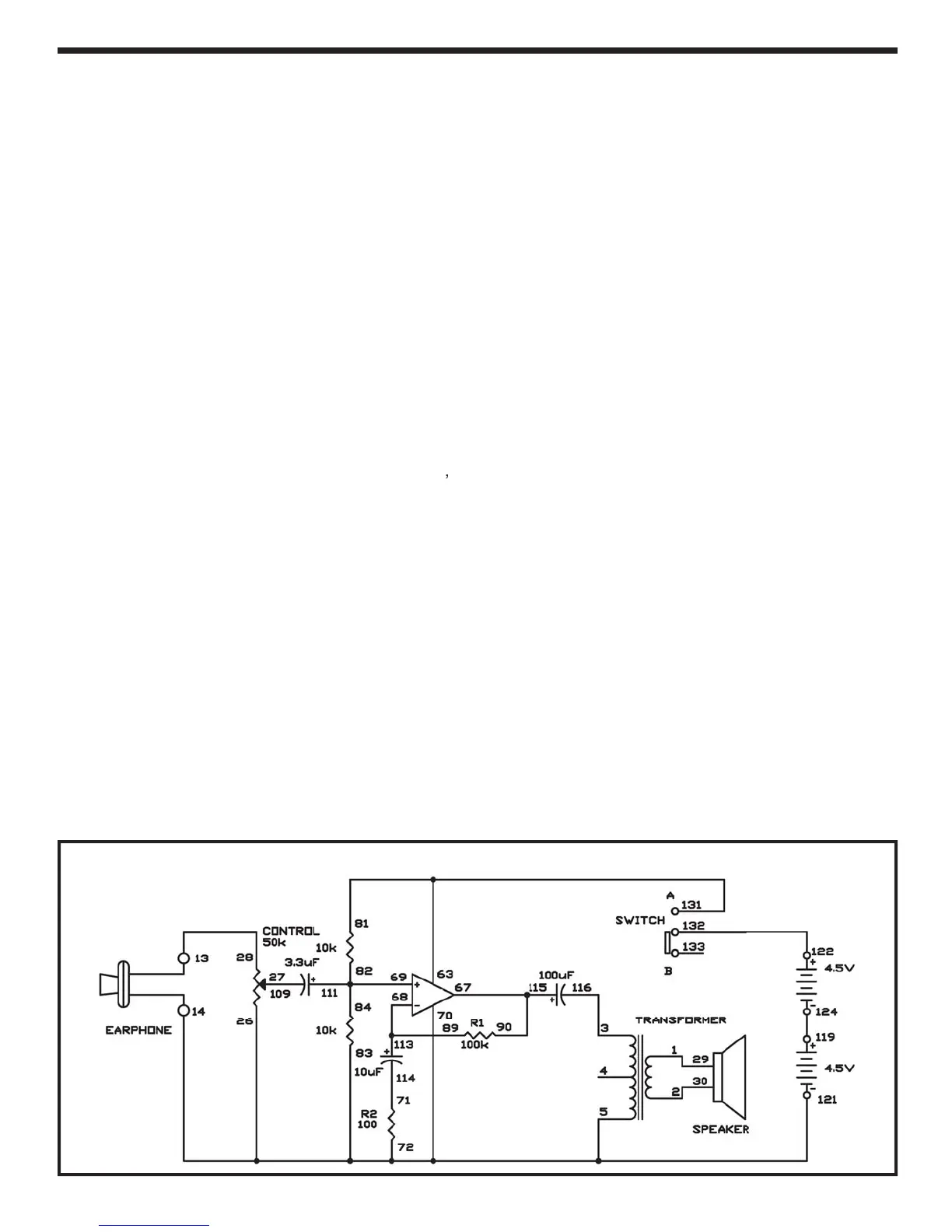
EXPERIMENT #74: NON-INVERTING AMPLIFIER
Wiring
equence
-2
2-3
-11
27-11
7
-
1-
-1
7-
-11
-
-
4-82-69-11
1
-12
22-1
21-26-70-83-72-5-14-EARPH
N
28-13-EARPHON
chematic






 To Next Page