-
-
This experiment is a pulse-tone oscillator with a
djustable frequency that can obtain a wide ran
e of
notes.
ou can p
ay tunes on
t t
at soun
e an
electronic organ, but it takes some practice.
To pla
a tune, modif
the control to the proper not
nd press the key. Readjust the control for the nex
note an
press t
e
ey a
a
n.
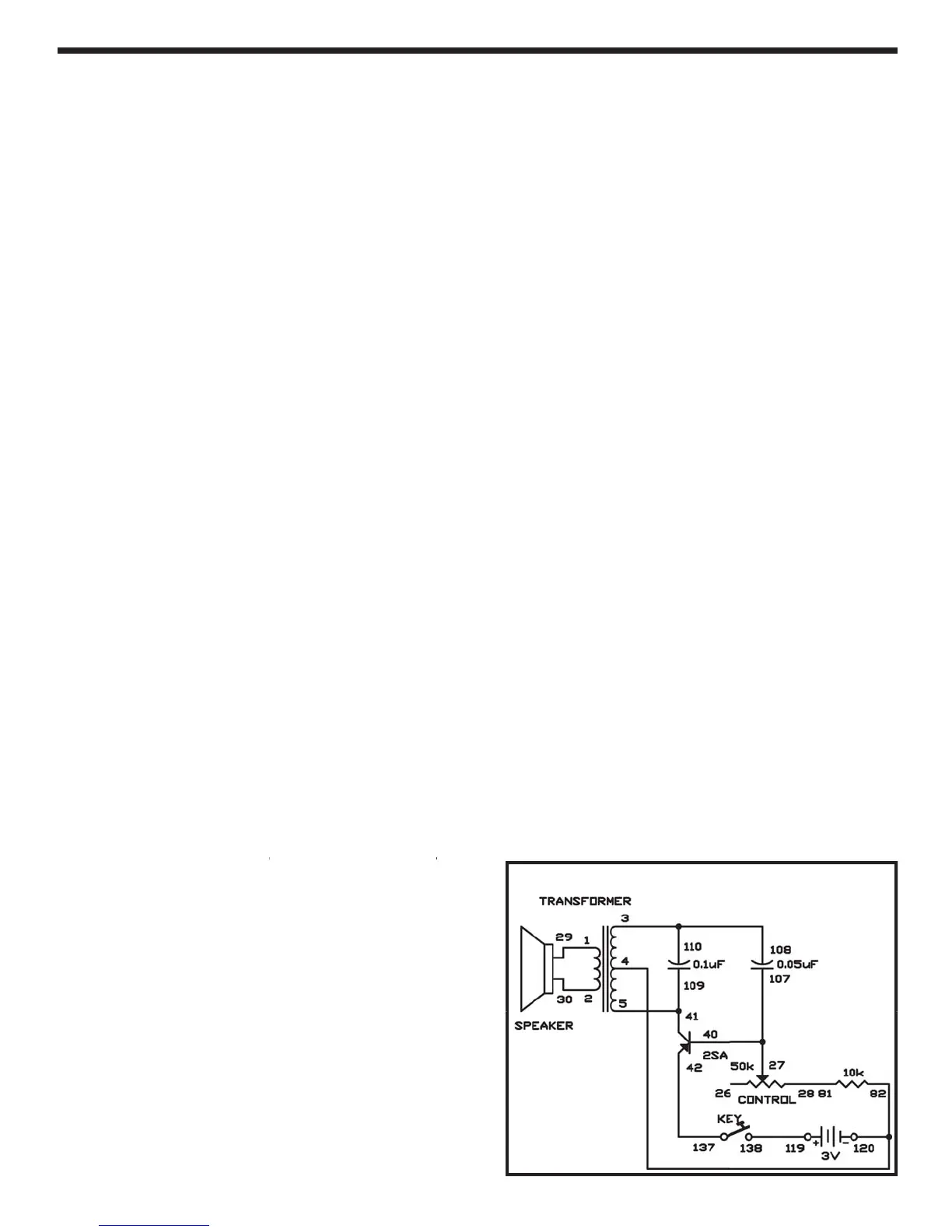
When you close the key the
irst time, the base
current
lows around the loop
ormed by the battery
the 10
resistor, the 50
resistor, the transistor
base and emitter, and the key.
The base current causes the collector current to flow
around the loop
ormed by the 3V supply, the lowe
al
o
the trans
ormer windin
, the transistor
co
ector an
em
tter, an
t
e
ey.
The current throu
h the trans
ormer causes a curren
to flow around the loop formed by the top transforme
w
n
ng, t
e 0.0
capac
tor, t
e trans
stor
ase
an
em
tter, t
e
ey, t
e
attery an
ac
to t
transformer’s center terminal
terminal 4
. Thi
current quickly (in less than 0.0001 seconds)
c
arges t
e 0.0
to a
out 4
or so w
t
a po
ar
t
egative on the trans
ormer side and positive on th
transistor base lead side. The speaker is onl
activated while the current
lows in the trans
ormer
When the induced volta
e
rom the top hal
o
the
transformer windin
stops, the char
in
of the
.
5
F capacitor stops, then the capacitor begins to
c
arge aga
n.
s soon as t
e
sc
arge
eg
ns, t
capacitor volta
e becomes hi
her than the battery
vo
tage.
e reverse po
ar
ty vo
tage
s app
e
to t
e
base and the transistor turns o
. Now
all transistor
unctions act as open circuits. The capacitor
discharges around the loop
ormed by the top
transformer winding, the 10k
resistor. When you reduce the control setting, th
dischar
e is
aster, so the process is repeated at
aster rate causing a higher
requency. The cycle
repeats when the 0.05
F capacitor discharges to
slightly below the 3V of the battery.
N
t
EXPERIMENT #12
: P
L
E T
NE
ENERAT
Schemati







 To Next Page