DPSI RV Mini Family Operating Instructions Version 1.0
Page 16 of 54
5.6. HFIB (High Frequency Interference Blocking)
In order to even increase safety, a highly effective filter is looped in into
each servo's signal path. Disturbances, "caught" by long servo cables
are almost completely eliminated directly at the servo connector and
therefore do not reach the receiver. Ferrite cores, as often utilized, can
be omitted, which saves weight and cost. The filters in the DPSI RV
Mini are tremendously more effective than cheap ferrite cores; their
effectiveness is controversial anyway.
5.7. Built-in V-Cable
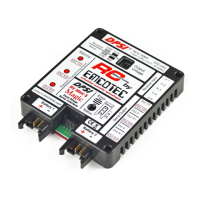
Depending on the system (Mini 5 or Mini 6) V-cables are built in to the
DPSI. This means, two servos can be connected to one receiver
output. This is especially handy, if two servos actuate one rudder (e.g.
the aileron of a larger acrobatic plane). The DPSI RV Mini 5 has three,
the Mini 6 one built-in V-cable (e.g. for the yaw
rudder and nose gear).
5.8. Servo-Matching ("Magic" option only)
DPSI RV Mini with "MAGIC" option allow for setting the servos which
are connected to V-cables arbitrarily, i.e. direction, center- and end-
limit positions.
This means: one receiver channel serves actually two servos; their
direction, center position and end positions can be aligned. A split
elevator rudder can be controlled by one servo on each side with one
single receiver channel. Therefore one receiver channel and one mixer
in the transmitter get freed up.
The same holds true for controlling the yaw
rudder with coupled nose
gear. Here too, "matching" helps to adapt both servos and saves one
channel.
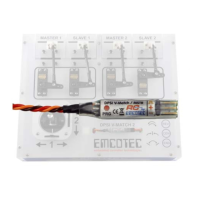
There is no external programming device (e.g. a PC) necessary for
programming or adapting the servos. A delivered magnet initiates
programming.



 To Next Page