INNOVATION AND FLEXIBILITY
THE
INSTALLATION AND MAINTENANCE TRAINING MANUAL
3.7.8 Stone Impingement
When installing a direct bury m/d bundle, care needs to be taken that stones or rocks do not come into contact with the m/d bundle. If this were
to happen and the ground subsequently compacted then the m/d bundle could suffer very high point loads resulting in a restriction in one or
more of the m/d bores.
To avoid this possibility it is essential that the bottom of the trench be graded after excavation and then covered with a suitable fine bedding
material such as sand to a depth of at least 70 mm (3”). The m/d bundle should be placed on top of this bedding layer and then a further layer of
sand applied to ensure that the top of the m/d bundle has a cover of at least 50 mm (2”)of fine material. The trench can then be back filled with
“rock-free” material and compacted. Remember also that sand subject to sub-zero temperatures can develop hard lumps that behave like rocks.
Careful preparation of the trench helps prevent problems that require costly dig-up.
3.7.9 Thermal Effects
When installing tube bundles in high temperatures, 30°C (85°F) or more, the trench should be back filled, as described above, but compaction
of the trench should be left overnight to allow the temperature of the m/d bundle to stabilise at the below ground temperature. Similarly
installation of closures and connectors should be carried out after the m/d bundle has been left overnight to allow the temperature of the m/d
bundle to stabilise at the below ground temperature. Plastic materials in common with other materials expand as they are heated and it is
important that this expansion is allowed to recover by leaving the m/d bundle in the back filled trench overnight before applying closures and
connectors. See also page 35.
3.7.10 Conduit Installation
Conduits shall be installed at temperatures in accordance with the manufacturer’s declaration. Proper installation is critical for a trouble-free
direct bury project. An example of a UK practice that has been found to be effective is shown on page 28.
3.8 Direct Installation – Blowing into a subduct
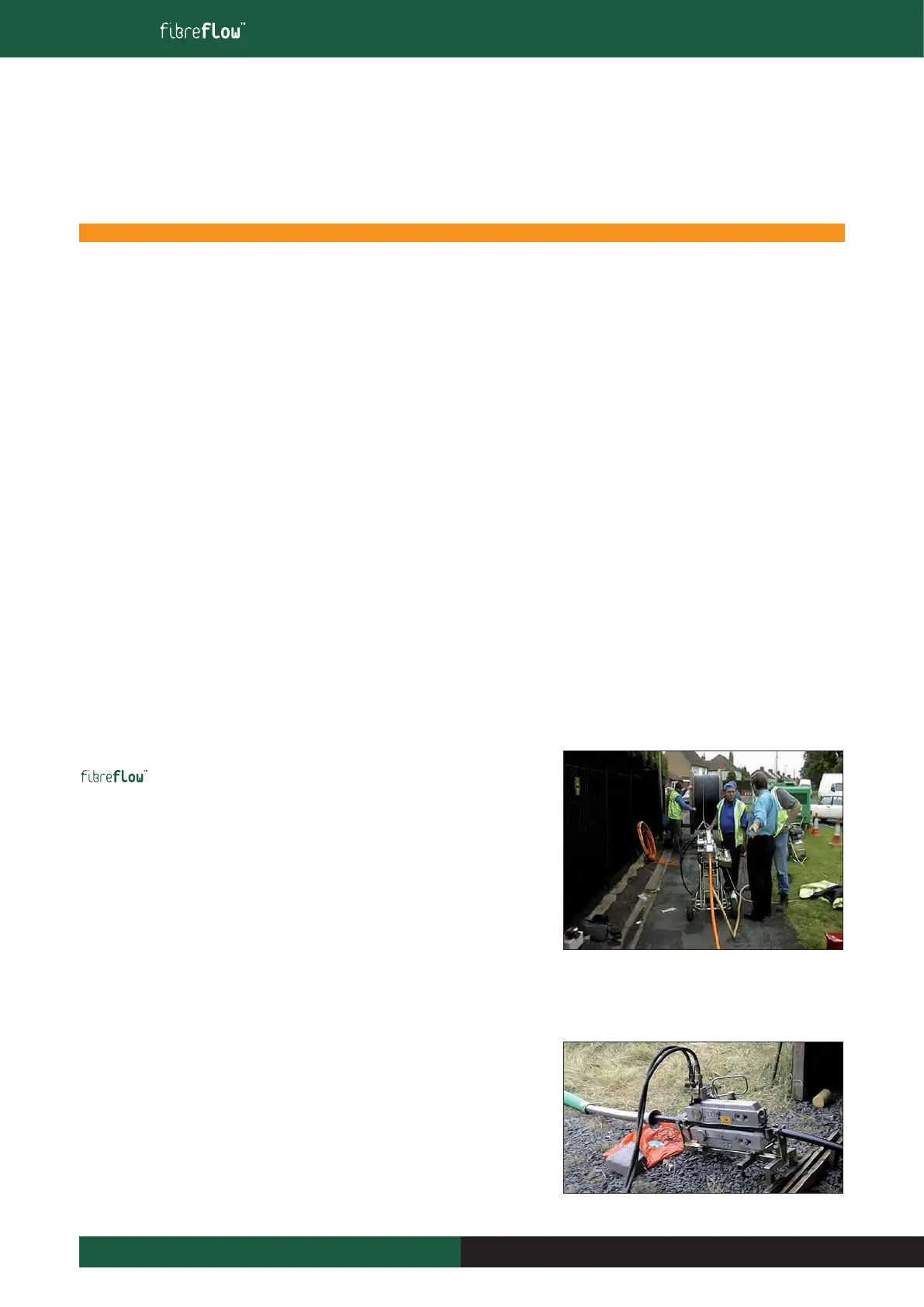
may also be blown into a subduct. Available equipment uses airflow and a
caterpillar pushing device to propel the cable forward. Installation performance may be
improved by using a cable lubricant* at the duct entry which will reduce the surface friction
between the cable and the subduct. Ensure the cable is free to feed into the blowing unit,
preferably from a secure stand or drum trailer.
*Never use lubricant on fibre unit. It must stay dry.
Blowing a cable (or protected microduct) with a diameter ‘d’ into a duct of ID 1.5d to
2d gives optimum installation performance. A general guidance rule for blowing a
cable into a duct is for the cable not to occupy more than 60% of the duct cross
sectional area. More typically, a limit might be 50% of the duct cross sectional area. This means that the smallest duct ID would normally be
1.3 times the cable OD. Trying to blow a cable into a duct of ID only 1.2 times the cable diameter may fail.
3.8.1 Ducts that are not empty
Blowing into a congested duct needs extra force and pre-installing a rope or using
airflow may not be possible. The cable can be pushed without the use of air into a
congested duct using the hydraulic drive only. How far depends on the stiffness of the
cable being deployed, the route and the amount of space available in the duct.
When pushing, the unit must be braced against a solid backstop such as the wall of
a manhole. Careful observation is needed to prevent damage caused by excessive
pushing force.
3 Outdoor Installation
“This document is intended as a guide only. Whilst the information it contains is believed to be correct, Emtelle can take no responsibility for actions taken based on the information contained in this document. Emtelle reserves the
right to make changes to this document without notice. All sales of product are subject to Emtelle’s terms and conditions of sale only, which can be found on Emtelle’s website.”
22
INNOVATION AND FLEXIBILITY



 To Next Page