INNOVATION AND FLEXIBILITY
9.2 Blowing Set-Up
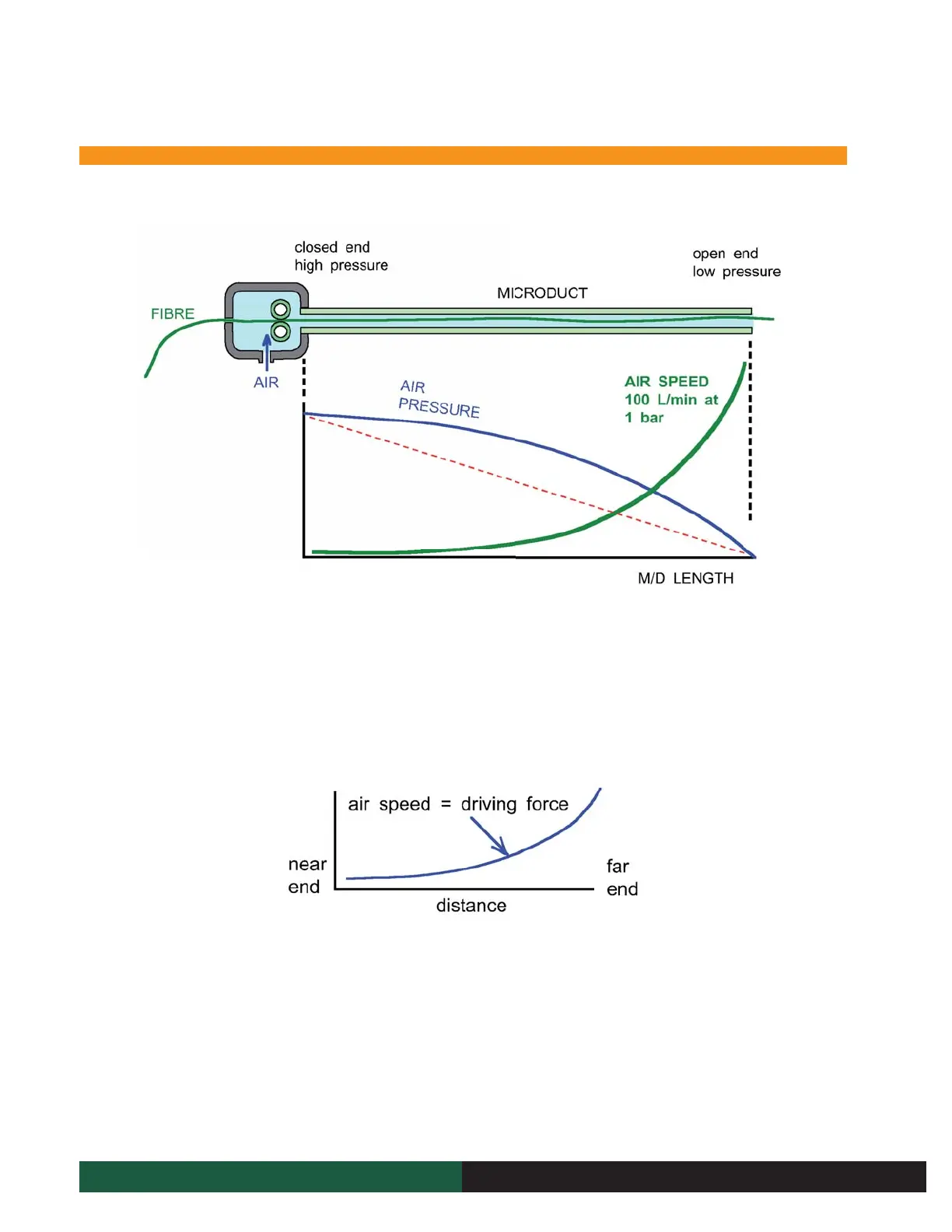
Remember the pressure drop is not a straight line, but is steeper at the far end. So the air flows very fast at the FAR END, providing the BEST DRIVING FORCE
there. The air has travelled nearly 75% of the way before its pressure drops to half. And at the start the air pressure falls only slightly, and so the flow (air
drag) is pretty weak, making the beginning of the route ‘sensitive’. That’s partly why we need drive wheels at the start. By the time the effect of the driving
wheels is weakening, the airflow is strengthening and should ‘take over’ the driving task.
We know that if a fibre begins to buckle in a m/d the first thing we can do is to turn down the speed of the drive wheels/FU. What we are doing in
effect increases the air flow relative to the FU which will increase the forward drag on the FU, reduce the buckling, and help the FU move.
Because the driving force from the airflow is LOW at the start, any bends at the start can be tricky to pass. But at the far end, in the high-speed
airflow, and high air-drive propulsion, the FU hardly notices the bends. Remember the airflow plot:
So, in any blow section, the installer must decide which end to blow from. Blowing should preferably be done so that bends are located at or near the
far end of the route (the 2nd half of the route).
9.3 Performance – How Far Will it Blow?
One indication of a m/d length that is too long for the tube/air combination, is when the FU buckles after say 40 or 50m. This is the point where the
driving wheel force has reduced to near zero, yet the forward air drag is still very low. If the FU succeeds in passing this ‘hesitation’ stage, to where air
flow is higher, it may well recover to full speed and exit well.
One technique for getting a stalled FU to continue, is to break open the route at some middle position, eg undo a connector in a ‘central’ closure. This
will seriously shorten the airflow length and permit the stalled FU now to proceed. Once it has reached the opened connector, re-close the connector.
The FU is now half-way, and hopefully past the ‘stall’ point described above. There is more on this topic in the following pages.
9 Fibre blowing
“This document is intended as a guide only. Whilst the information it contains is believed to be correct, Emtelle can take no responsibility for actions taken based on the information contained in this document. Emtelle reserves the
right to make changes to this document without notice. All sales of product are subject to Emtelle’s terms and conditions of sale only, which can be found on Emtelle’s website.”
74
INNOVATION AND FLEXIBILITY



 To Next Page