7.2 RS232 / RS485 Output
7.2.1 Introduction
The RS232C output option consists of an additional card (reference
P01
3193
06
) that is installed in the M2 plug-in connector of
the instrument’s main board. The card incorporates one 4 wires telephone socket with output at the rear of the instrument.
The RS485 output option consists of an additional card (reference
P01
3193
07
) that is also installed in the M2 plug-in connector
The serial output permits to construct a communication line through which a master device can request the transmission of data
such de display value, setpoint values, peak, valley, tare (or offset in case of thermometers) and to perform operations such as
tare of the display, reset of the peak, valley or tare memories and update setpoint values..
The output option is totally software configurable as for the transmission rate (1200, 2400, 4800, 9600 ó 19200 Baud), the
instrument’s address (from 00 to 99), the protocol (ASCII, ISO 1745 and MODBUS RTU).
The operating mode is half-duplex and it normally stands in data reception mode until reception of a message.
A valid data transmission may cause the immediate execution of an action (tare, reset of peak, valley or tare memories
modification of setpoint values) or the transmission of a response from the instrument (display value, one of the setpoints value,
peak, valley, tare / offset).
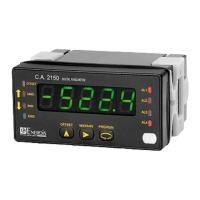
From the site web http://www.chauvin-arnoux.com/ can be downloaded the specific software that allows to connect
the CA2150 instruments to a PC and whole programming, as well as to verify its communication’s hardware.
Three communication modes are available; the ASCII mode uses a simple protocol compatible with several CA2150 instruments.
The ISO mode, in accordance with the ISO 1745 norm, allows a more effective communication in noisy environments as it checks
the messages validity checking both transmission and reception. And eventually the protocol MODBUS RTU
As you will see in the functions table, the protocol ASCII uses 1 or 2 bytes according to the command type and the protocol ISO
1745 imposes the use of two bytes per command.


 To Next Page