165
WSG-1068 IGNITION SYSTEM
WARNING: WHEN CARRYING OUT
SERVICE OPERATIONS ON AN ENGINE
EQUIPPED WITH DISTRIBUTORLESS
IGNITION. FOLLOW ALL THE USUAL
SAFETY MEASURES TO PREVENT THE
POSSIBILITY OF ELECTRIC SHOCKS
SHOULD BE FOLLOWED.
NOTE: High tension voltage produced by a
distributorless ignition system is higher than for a
conventional ignition system. It is in excess of 55,000
Volts.
Description
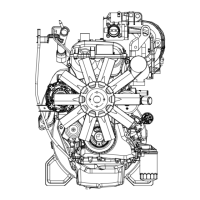
The WSG-1068 engine uses a Coil On Plug Ignition
System to ignite the fuel/air mixture at the correct time
and sequence based upon the input it receives. The
brain of this system is a Global Control Platform (GCP).
The GCP has the capability at the OEM option to protect
the engine from over heating and low oil pressure. Inputs
are sensors or switches that feed the GCP information.
Engine Cylinder Head Temperature Sensor
(CHT) Input.
Camshaft Position Sensor (CMP) Input.
Crankshaft Position Sensor (CKP) Input.
Fuel Select Switch.
From these inputs, the GCP computes spark strategy
(spark advance) and fuel mixture (air/fuel) to obtain
optimum engine performance for correct load conditions.
Operation
The ignition control module needs the following
information to calibrate the engine properly:
Crankshaft position.
Engine RPM.
Engine temperature.
Engine load and altitude.
Fuel select switch.
The camshaft position sensor (CMP sensor):
Sends the Ignition Control Module a signal
indicating camshaft position used for fuel
synchronization.
The crankshaft position sensor (CKP sensor):
Sends the Ignition Control Module a signal
indicating crankshaft position.
Is essential for calculating spark timing.
The intake air temperature sensor (IAT sensor):
Sends the ignition control module a signal
indicating the temperature of the air entering the
engine, but is not used on this engine.
Resistance decreases as temperature
increases.
The cylinder heat temperature (CHT sensor):
Sends a signal to the Ignition Control Module
indicating the cylinder head temperature.



 To Next Page