238
WSG-1068 STARTER SYSTEM
DIAGNOSIS AND TESTING
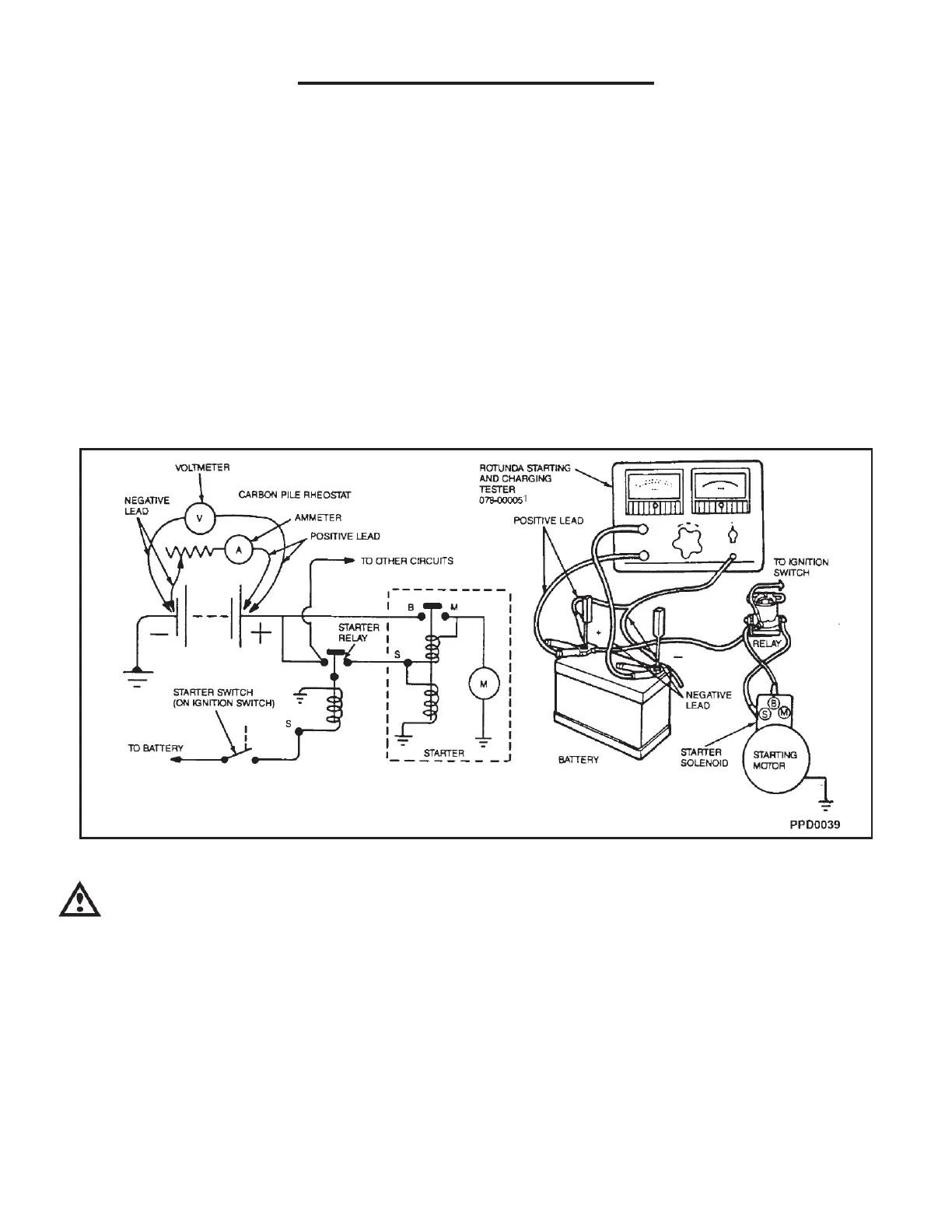
Starter Load Test
Conduct this test if the starter cranks slowly and it is
desired to compare current to specifications.
1. Connect Rotunda Starting and Charging Tester
078-00005 or equivalent. Make sure that current
is not flowing through ammeter and heavy-duty
carbon pile rheostat portion of circuit (rheostat at
maximum counterclockwise position).
2. Disconnect load from engine. Place
transmission in NEUTRAL. Crank engine with
ignition off, and determine exact reading on
voltmeter. This test is accomplished by
disconnecting push-on connector “S’’ at starter
relay and by connecting a remote control starter
switch from positive battery terminal to “S’’
terminal starter relay.
3. Stop cranking engine and reduce resistance of
carbon pile until voltmeter indicates same
reading as that obtained while starter cranked
the engine. The ammeter will indicate starter
current draw under load. Check this with value
listed in Specifications on page 07-19.
Bench Tests
CAUTION: Make sure that the starter is
securely mounted in bench vise while energizing,
as starter will move or jump.
1. Connect a fully charged battery, Rotunda
Starting and Charging Tester 078-00005, or
equivalent. Make sure that the battery and
starter motor are grounded.
2. Engage the remote starter switch.
3. The starter motor should eject the starter drive
and run smoothly. If the starter motor does not
run smoothly, replace it.
4. While the starter motor is running, check the
voltmeter and ammeter.
5. If the voltage is lower than the 11.0 volts, or the
amperage is higher than 70 amps, replace the
starter motor.
NOTE: Service parts for rebuilding permanent magnet
starter are not available from Ford Power Products.
1Rotunda 1-800-578-7375



 To Next Page