244
WSG-1068 STARTER SYSTEM
Component Tests
Starter Motor - Voltage Drop Test
WARNING: WHEN REPAIRING THE STARTER
MOTOR OR PERFORMING OTHER UNDERHOOD
WORK IN THE VICINITY OF THE STARTER MOTOR,
BE AWARE THAT THE HEAVY GAUGE BATTERY
INPUT LEAD AT THE STARTER SOLENOID IS
“ELECTRICALLY HOT” AT ALL TIMES. WHEN
SHORTED TO GROUND, MAY CAUSE PERSONAL
INJURY.
CAUTION: A protective cap or boot is provided over
the battery input terminal on all vehicle lines and
must be replaced after repairing. Failure to replace
protective cap could cause electrical short that may
damage electrical system. Be sure to disconnect
the battery ground cable before repiaring the starter
motor.
NOTE: Always connect the 73 Digital Multimeter at the
component terminal rather than at the wiring end
connector. Making a connection at the wiring end
connector could result in false readings because the
meter will not pick up a high resistance between the
wiring connector and the component.
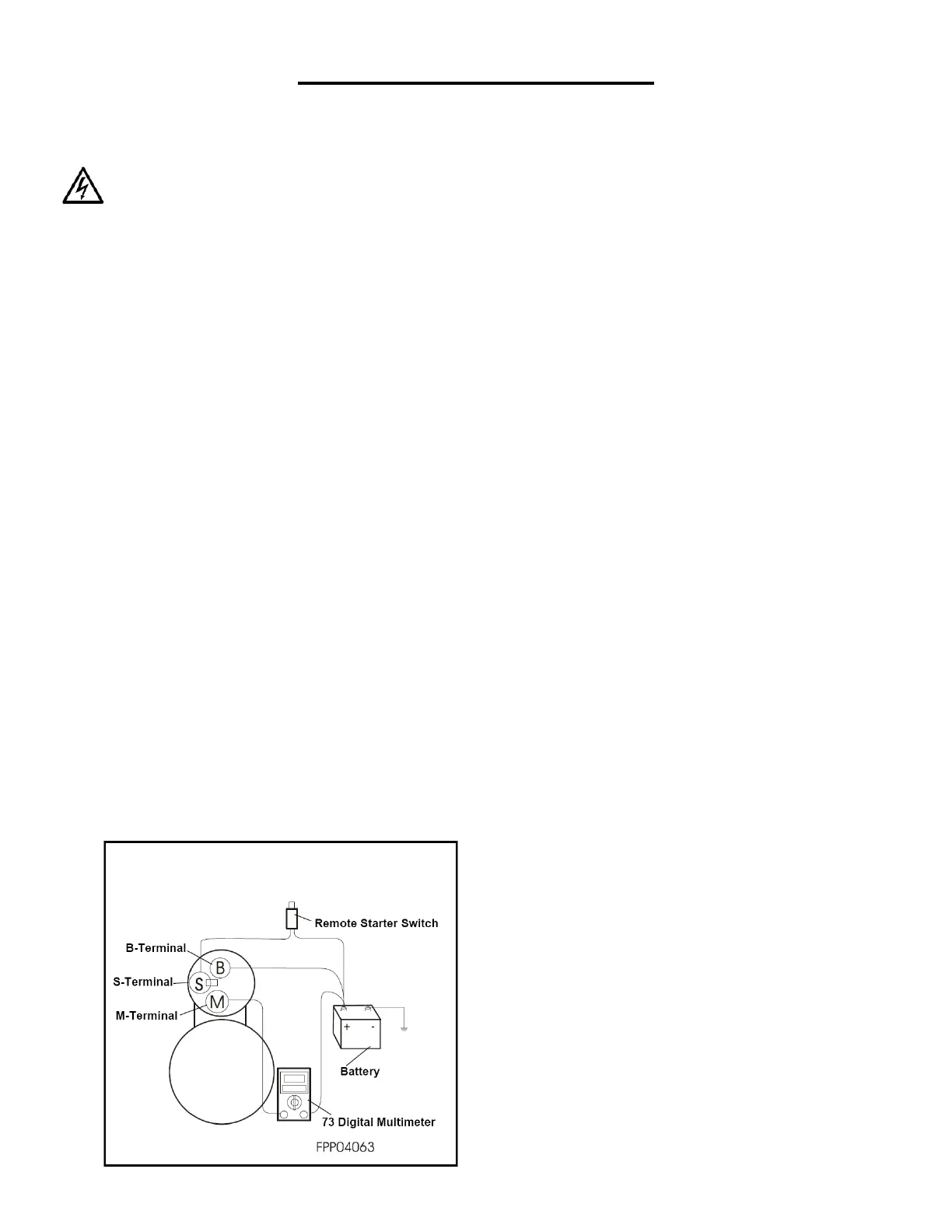
Starter Motor - Motor Feed Circuit
1. Make sure the battery is fully charged.
2. Connect a remote starter switch between the
starter motor solenoid S-terminal and the battery
positive (+) terminal.
3. Connect the 73 Digital Multimeter positive lead
to the battery positive (+) post. Connect negative
lead to the starter motor solenoid M-terminal.
4. E
n
gage the remote starter switch. Read and record
the voltage. The voltage reading should be 0.5
volts or less.
5. If the voltage reading is 0.5 volts or less -- Refer
to“Starter Motor - Motor Ground Circuit” on page
14.
6. If the voltage reading is greater than 0.5 volts,
indicating excessive resistance, move the 73
Digital Multimeter negative lead to the starter
motor B-terminal and repeat the test. If the
voltage reading at the B-terminal is lower than
0.5 volts, the concern is either in the
connections at the starter motor solenoid or in
the starter motor solenoid contacts.
7. Remove the cables from the starter motor
solenoid B-, S- and M-terminals. Clean the
cables and connections and reinstall the cables
to the proper terminals. Repeat Steps 3 through
6. If the voltage drop reading is still greater than
0.5 volts when checked at the M-terminal or less
than 0.5 volts when checked at the B-terminal,
the concern is in the solenoid contacts. Replace
the starter motor.
8. If the voltage reading taken at the starter motor
solenoid B-terminal is still greater than 0.5 volts
after cleaning the cables and connections at the
solenoid, the concern is either in the positive (+)
battery cable connection or in the positive
battery cable itself.
9. By moving the 73 Digital Multimeter negative
lead toward the battery and checking each
mechanical connection point, the excessive
voltage drop can be located. When the high
reading disappears, the last mechanical point
that was checked is the concern. Repair or
replace this connection as required.



 To Next Page