The Harmonizer
®
Programmer’s Manual
© 1999-2008 Eventide, Inc. Page 10 of 97 Release 1.3
MODULES
Modules are the magic that make the Harmonizer shine. They are signal processing “nuggets” that are
interconnected (via the signals discussed above). Before we discuss aspects of the typical modules like
the delay module, the filter module, the pitch shifter module, etc., we need to look at the
more specialized IN and OUT “modules."
The IN and OUT “Modules”
Orville, H8000
Orville’s programs are loaded and run one at a time on a given DSP. The DSP running the program
provides the program with four channels of input audio
(the source of that input audio is a function of the routing
configuration, see the Harmonizer’s User Manual).
Most H8000 family programs can run on one DSP, but it
also allows larger (monolithic) programs to be split
across two DSPs. The DSP(s) running the program also take(s) the four or eight channels of output
audio from the program (its subsequently destination is again a function of the routing configuration).
DSP7000, H7600
The H7600’s programs are loaded and run on its single DSP. The DSP provides the program with two
channels of input audio and takes two channels of output
audio from the program. The remainder of this manual
will show Orville-style four channel processing, but the
idea is the same with the H7600’s two channels. If you
send a program that has more than two inputs or outputs
to your H7600 from VSigfile, it will not be accepted.
The input audio and output audio connections to the program are handled
through a pair of pre-defined modules called IN and OUT.
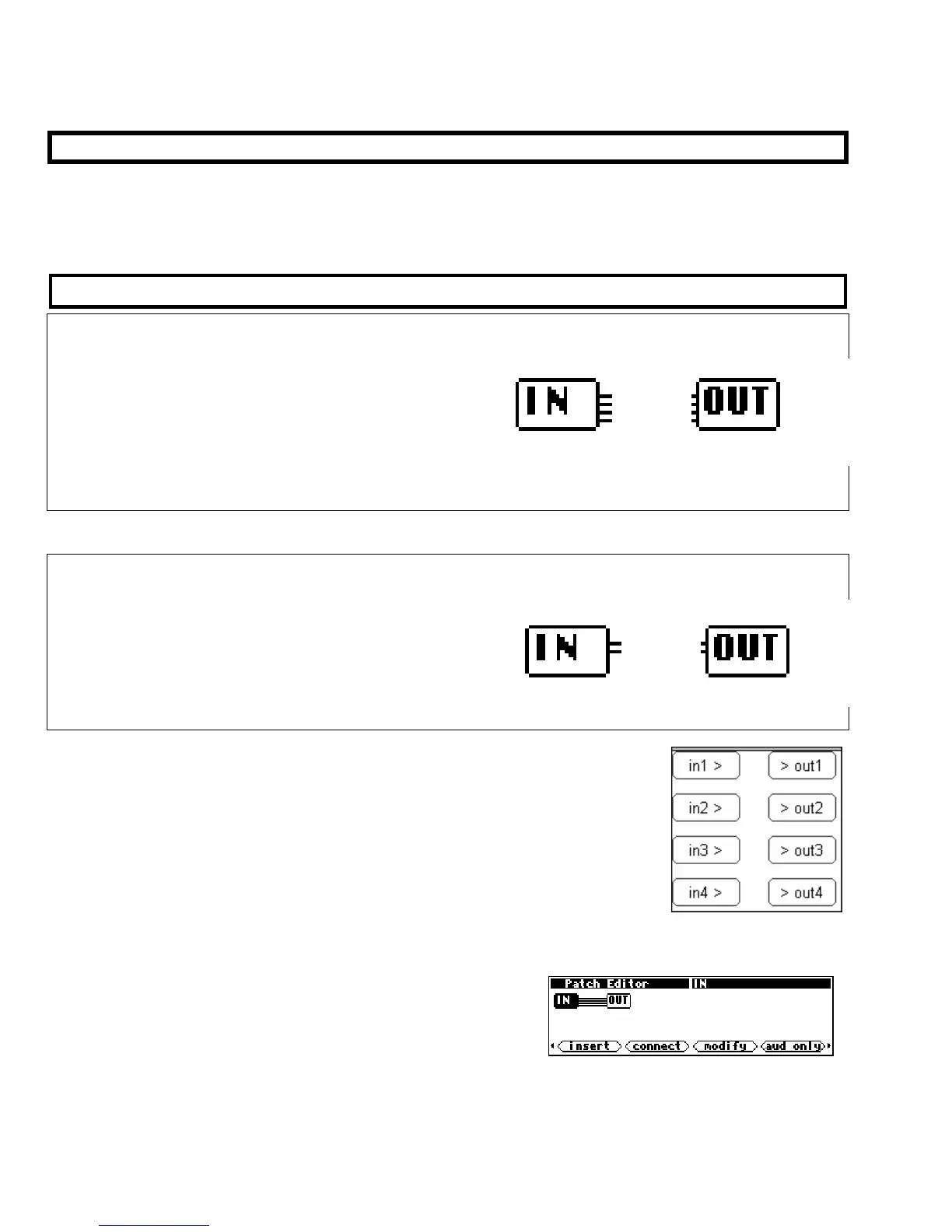
The IN module has up to four (eight on H8000) signals to send to the program,
labeled 1, 2, 3 etc. Since these signals are coming from the module, they are
called
outputs of the module. A small amount of confusion might result
because the IN module has outputs. Similarly, the OUT module has inputs
labeled 1, 2, 3 etc. This difficulty is minor compared to the gain in consistency
created by using the word
output to refer to all signals that come from a
module, and using the word input to refer to all signals that go into a module.
In the simplest of conceivable programs, the IN module’s
outputs are connected directly to the OUT module’s inputs
(this is the
Thru’ program in bank 0). Normally, other, optional
modules are inserted in-between the IN and OUT modules.
The IN and OUT modules always remain as part of the program.


 To Next Page