Need help?
Do you have a question about the Eventide H9000 and is the answer not in the manual?
Lists the items included with the H9000 unit.
Details the H9000's key capabilities like processors, I/O, and connectivity.
Explains the product's organizational structure: Session, FX Chain, Algorithm, Parameter.
Guides the user through initial configuration of the H9000 device.
Guides the user through initial configuration of the H9000R device.
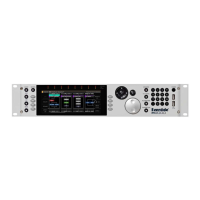
Details the controls and functions on the front panel of the H9000.
Details the controls and functions on the front panel of the H9000R.
Describes the various connectors and ports on the rear panel.
Explains the concept and visual distinction of latching soft keys.
Outlines essential rules for signal routing in the H9000.
Explains what Sessions are and how to navigate and load them.
Details how to view and edit FX chains, including configuration and replacement.
Guides users on how to navigate and manage algorithms within FX chains.
Explains how to adjust parameters within an algorithm to shape sound.
Describes the LED meters and how to assign signal sources to them.
Covers saving presets, sessions, FX chains, and exporting data.
Explains how to use Scenes for sequenced program changes and live control.
Introduces Emote, the control app for the H9000.
Details the main components of the Emote interface: Menu, Browser, Main Screen.
Explains how to use Emote within a Digital Audio Workstation (DAW).
Guides on setting and matching sample rates for USB audio.
Explains how to connect and use the H9000 as an audio interface on macOS.
Explains how to connect and use the H9000 as an audio interface on Windows.
Details the features and setup of the MADI expansion card.
Details the features and setup of the Dante expansion card.
Explains integration with Pro Tools via expansion cards.
Provides essential safety precautions for operating the unit.
Outlines the terms and conditions of the product warranty.
Details how warranty claims and procedures are handled.
Explains compliance with Class A ITE regulations.
Details compliance with CE Class A (EMC) directives.
Illustrates the path of audio signals through the H9000.
Illustrates the path of control signals within the H9000.
Describes how to perform a soft reset or enable access point mode.
Explains how to use recovery mode for firmware updates.
Details how to perform a factory reset on the H9000.
Covers backing up H9000 data via USB.
Explains how to run USB self-tests for diagnostics.
Uses note velocity as a control value.
Emits a trigger pulse when a note is played.
Flips between min/max values when a note is played.
Uses the note number as the control value.
Maps note pitch to frequency control.
Selects the controller's response range (0-127).
Controls how parameter values are applied based on controller input.
 General
| Type | Multi-Effects Processor |
|---|---|
| Channels | 8 |
| USB | USB 2.0 |
| Network | Ethernet |
| Power Supply | Internal |
| Form Factor | 2U Rackmount |
| Analog Outputs | 8 x XLR/TRS combo jacks |
| Digital Inputs | AES/EBU, ADAT, S/PDIF |
| Digital Outputs | AES/EBU, ADAT, S/PDIF |
| MIDI I/O | In, Out/Thru |
| Connectivity | Extensive |
| Software | Emote control software |
| Analog Inputs | 8 (XLR/TRS Combo) |

 To Next Page