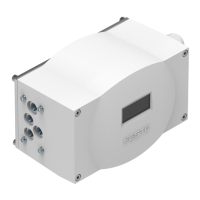
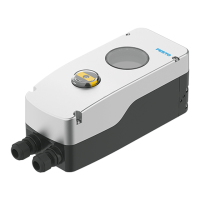
6.2 Electrical installation
6.2.1 Establish electrical connection
WARNING
Risk of injury due to electric shock.
• For the electric power supply, use SELV or PELV circuits that guarantee a reliable electric disconnec-
tion from the mains network.
• Observe IEC 60204-1/EN 60204-1.
WARNING
Fire risk from overheating.
Injury resulting from fire.
• The device must have a limited power supply in accordance with the following standard.
• IEC/EN/UL/CSA 61010-1 Safety of measuring, control and laboratory equipment
The cable connector and the blanking plugs are not in scope of delivery.
1.
Make sure that no energy is connected to the device.
2.
Select a suitable cable connector or insert a blanking plug.
–
Observe the temperature range.
– The cable connector must comply with protection class IP67.
– Connecting thread: M20x1.5 für CMSH-...-M20-..., 1/2 NPT for CMSH-...-N12-...
3.
Unscrew the housing cover screws.
4.
Remove the housing cover.
5.
Screw the cable connector into the threaded hole.
6. Guide the electrical connecting cable through the cable connector and connect the electrical
connection.
–
Select the electrical connecting cable suitable for the cable connector.
– Conductor cross section
è
Tab. 95 Electrical connection.
7.
Wire the electrical connections
è
6.2.2 Wiring diagram.
8. Tighten the union nut of the cable connector to seal the cable tightly.
9. Seal unused cable entries with a blanking plug.
10.
Connect the functional earth (FE) with low impedance
è
Fig. 1, [12].
– Tightening torque: 1 Nm ± 15%
11. If required, attach the cable screening connection to the functional earth (FE) inside the housing
è
Fig. 2, [7].
–
Tightening torque: 1 Nm ± 15%
12.
Replace the housing cover and tighten the 4 housing cover screws.
– Ensure that the seal is correctly positioned.
–
Tightening torque: 1 Nm ± 15%


 To Next Page