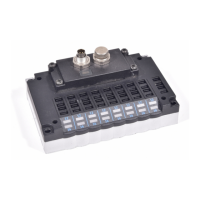
1. Summary of components
1−17
Festo P.BE−VTSA−44−EN en 0509NH
Pressure regulator plates
P−pressure regulator
(identifier R1−...−6 and
R1−...−10)
Mode of operation:
The P−pressure regulator regulates the pressure in front of
the valve in channel 1 (P). In this way channels 2 and 4 have
the same regulated pressure. During the exhaust procedure
the valve is exhausted from channel 2 to channel 3 and from
channel 4 to
channel 5.
The advantages of this pressure regulator are:
The pressure regulator is not affected by the exhaust
procedure because regulation takes place upstream of
the valve.
The pressure regulator can always be set, because the
pressure from het valve terminal is always present.
Application example:
An equally high working pressure is required at
work
connections 2 and 4.
A lower working pressure (e.g. 3 bar) is required than
the operating pressure present at the valve terminal
(e.g. 8 bar).
AB pressure regulator
(identifier R4−...−6 and
R4−...−10)
Mode of operation:
The AB pressure regulator regulates the pressure in chan
nels 2 (B) and 4 (A) when the pressure medium
has passed
through the valve. Exhausting takes place via the valve and
the pressure regulator from channel 2 to channel 3 and from
channel 4 to channel 5.
The following example shows the switch positions:
The supply air is passed from channel 1 through the pressure
regulator plate and through the valve to
pressure regulator
B, where it is regulated and then passed to connection 2 of
the manifold sub−base. The exhaust is passed via channel 4
to the pressure regulator and then via the valve in channel 5.



 To Next Page