Main Differential Lock Operation
NOTICE
The differential lock should be engaged when the
vehicle is stopped or moving at a low, constant
speed and the wheels are not spinning, slipping,
or losing traction. Engagement at high speed or
power can damage the axle(s).
Do not permit rear wheels to spin freely for more
than ten seconds when traction is lost. Shift into
LOCK to prevent damage to interaxle and main
differentials.
To lock the main differential and obtain maximum
traction under slippery conditions, move the control
switch to the lock position.
NOTE: On some vehicles, the differential lock
system is connected through the low speed
range of the transmission. If this system is used,
the transmission must be in the low speed
range for the differential to fully lock.
If the vehicle is moving, maintain a constant vehicle
speed while engaging the differential lock. Briefly let
up on the accelerator to relieve torque on the gear-
ing, allowing the differential to fully lock. The indica-
tor light should come on and the buzzer should
sound on vehicles so equipped. When the differential
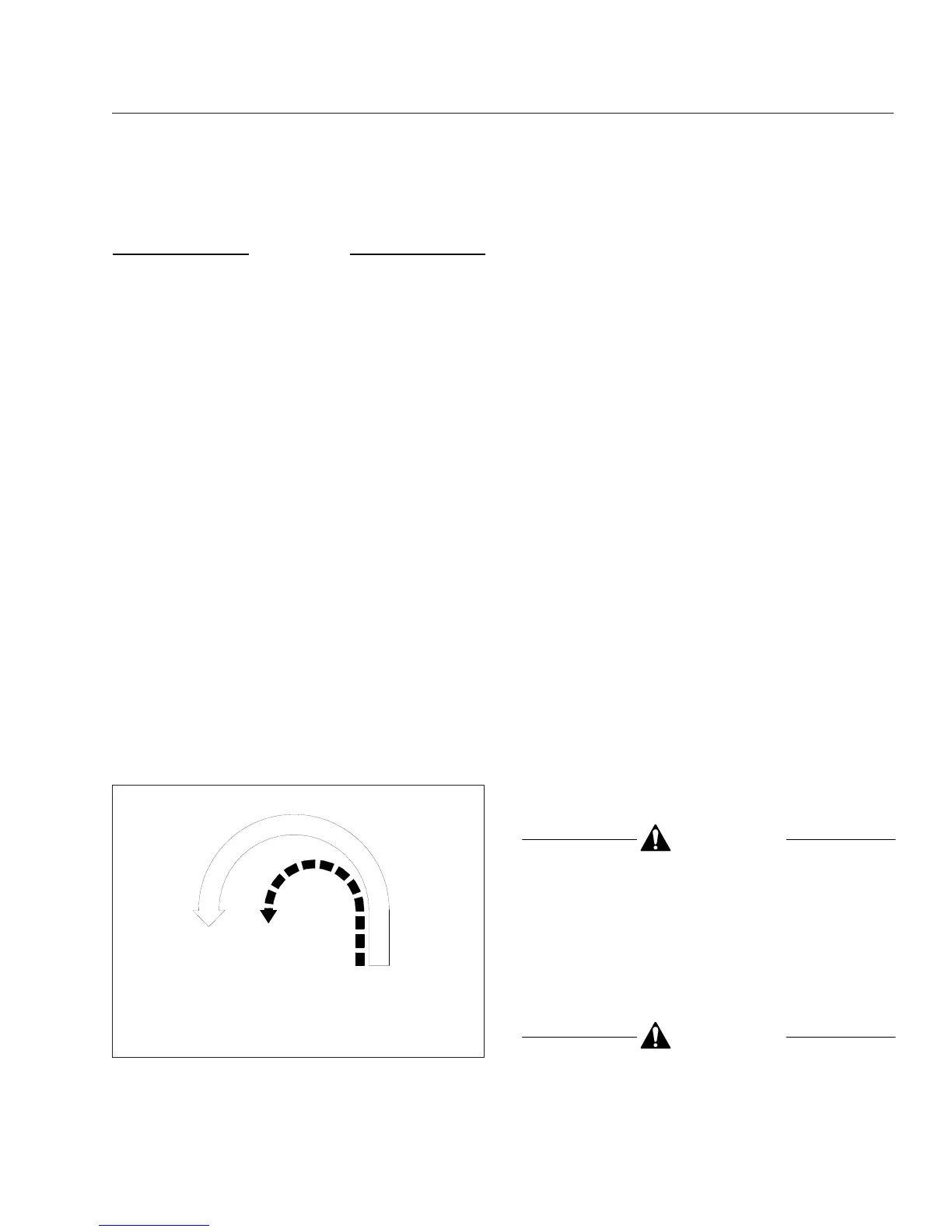
is fully locked, the turning radius will increase be-
cause the vehicle understeers. See
Fig. 16.1. Drive
cautiously and do not exceed 25 mph (40 km/h).
To unlock the main differential, move the control
switch to the unlock position. Briefly let up on the
accelerator to relieve torque on the gearing, allowing
the differential to fully unlock.
NOTE: If the differential lock system is con-
nected through the low speed range of the
transmission, shifting out of low speed range will
also unlock the differential.
When the differential lock disengages, the indicator
light will go off and the buzzer will stop.
Single Drive Axles with Traction
Equalizer
Some single drive axles are equipped with a traction
equalizer that is a load-sensing, self-actuating fea-
ture. A traction equalizer provides normal differential
action where traction is good. When one wheel be-
gins to spin faster than the other, clutch plates in the
differential housing automatically engage, delivering
power to both wheels. There is no operator control
with this feature.
A traction equalizer occasionally tends to slip in a
jerking motion, producing irregular intervals of sharp
noises. This generally occurs when the vehicle is op-
erating at low speeds on fairly sharp turns. This con-
dition is corrected by adding a friction modifier to the
axle lubricant. This additive tends to reduce the static
coefficient of friction to a value equal to, or lower
than, the sliding coefficient.
See Group 35 of the Cascadia
™
Maintenance
Manual for additional information on friction modifiers
and when to add them to axle lubricants.
CAUTION
Tire sizes on both rear wheels should be the
same on axles equipped with a traction equalizer.
If not, excessive wear may occur in the traction
equalizer.
Two-Speed Drive Axles
Axle Shift
CAUTION
To prevent transmission and axle damage, make
sure the automatic transmission is in high range
02/09/96
f350079a
A
B
A. Turning Radius When Differential is Locked
(engaged)—Understeer Condition
B. Turning Radius When Differential is Unlocked
(disengaged)
Fig. 16.1, Turning Radius
Drive Axles
16.2



 To Next Page