Power Steering System
General Information
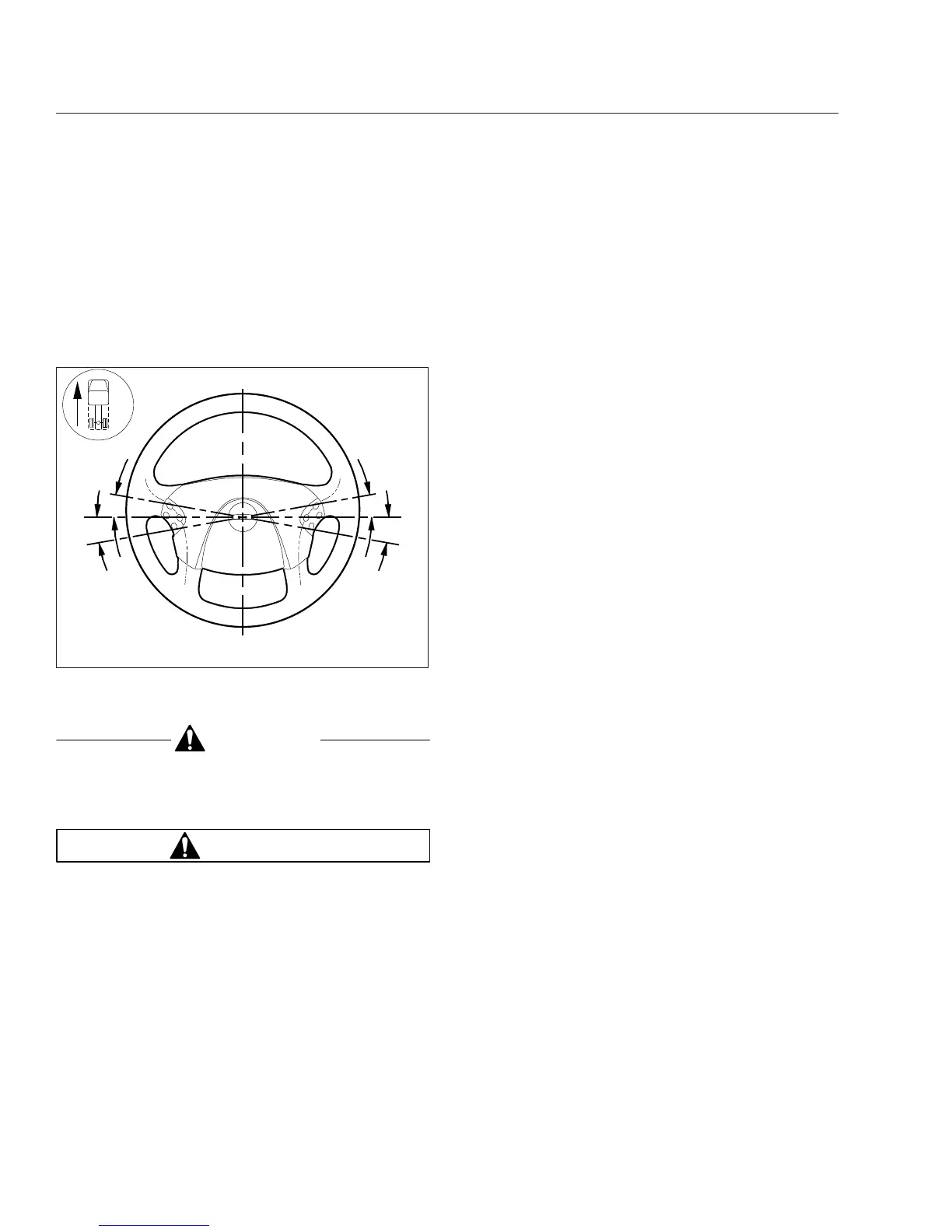
When there is no load on the vehicle, and the front
tires are pointed straight ahead, the steering wheel
spokes should be centered, ±10 degrees, as shown
in
Fig. 17.1. See Group 46 of the Cascadia
™
Work-
shop Manual for steering adjustment procedures.
CAUTION
Never steam clean or high-pressure wash the
steering gear. Internal damage to gear seals, and
ultimately the steering gear, can result.
WARNING
Driving the vehicle without the power-assist fea-
ture of the steering system requires much greater
effort, especially in sharp turns or at low speeds,
which could result in an accident and possible
injury.
Drivers should carefully use the power available with
a power steering system. If the front tires become
lodged in a deep chuckhole or rut, drive the vehicle
out, instead of using the steering system to lift the
tires from the hole. Also, avoid turning the tires when
they are against a curb, as this places a heavy load
on steering components and could damage them.
Power Steering Systems
Steering Gear System
The steering gear system includes the power steer-
ing gear, hydraulic hoses, power steering pump, res-
ervoir, and other components. Some models are also
equipped with a separate hydraulic power cylinder on
the right side of the front axle, or a right-hand slave
gear (such as the TRW RCH-45). The power steering
pump, driven by the engine, provides the power as-
sist for the steering system. If the engine is not run-
ning, there is no power assist. If the power-assist
feature does not work due to hydraulic fluid loss,
steering pump damage, or some other cause, bring
the vehicle to a safe stop. Do not drive the vehicle
until the cause of the problem has been corrected.
Rack and Pinion Steering System
The rack and pinion steering gear is mounted to the
front axle with two brackets, and connected by tie-
rod ends to the axle steering arms. When the steer-
ing wheel is turned, the intermediate steering shaft
turns the input shaft, rotating the torsion bar and the
valve. When the valve turns, power steering fluid is
redirected and provides power assist to turn the pin-
ion gear meshed with the rack teeth, moving the rack
left or right. The rack, with a tie-rod at each end,
then moves the steering arms on the axle, and pivots
the wheels.
This design provides drivers with more responsive
steering, with increased performance and “road feel.”
It virtually eliminates steering issues when the driver
hits a bump (bumpsteer), and significantly reduces
roll steer when a vehicle goes into a curve. Wander-
ing is significantly reduced as well, so the vehicle
tends to drive straight on the highway. It has a lower
steering ratio, which means drivers don’t have to turn
the steering wheel as much to get the wheels to turn
a given distance. Overall, rack and pinion steering
greatly improves steering response, and reduces
driver effort and fatigue.
06/13/2007
f462080
10°
10°
1
2
10°
10°
1. 9 o’Clock 2. 3 o’Clock
Fig. 17.1, Proper Steering Wheel Position (with tires
pointed straight ahead)
Steering System
17.1



 To Next Page