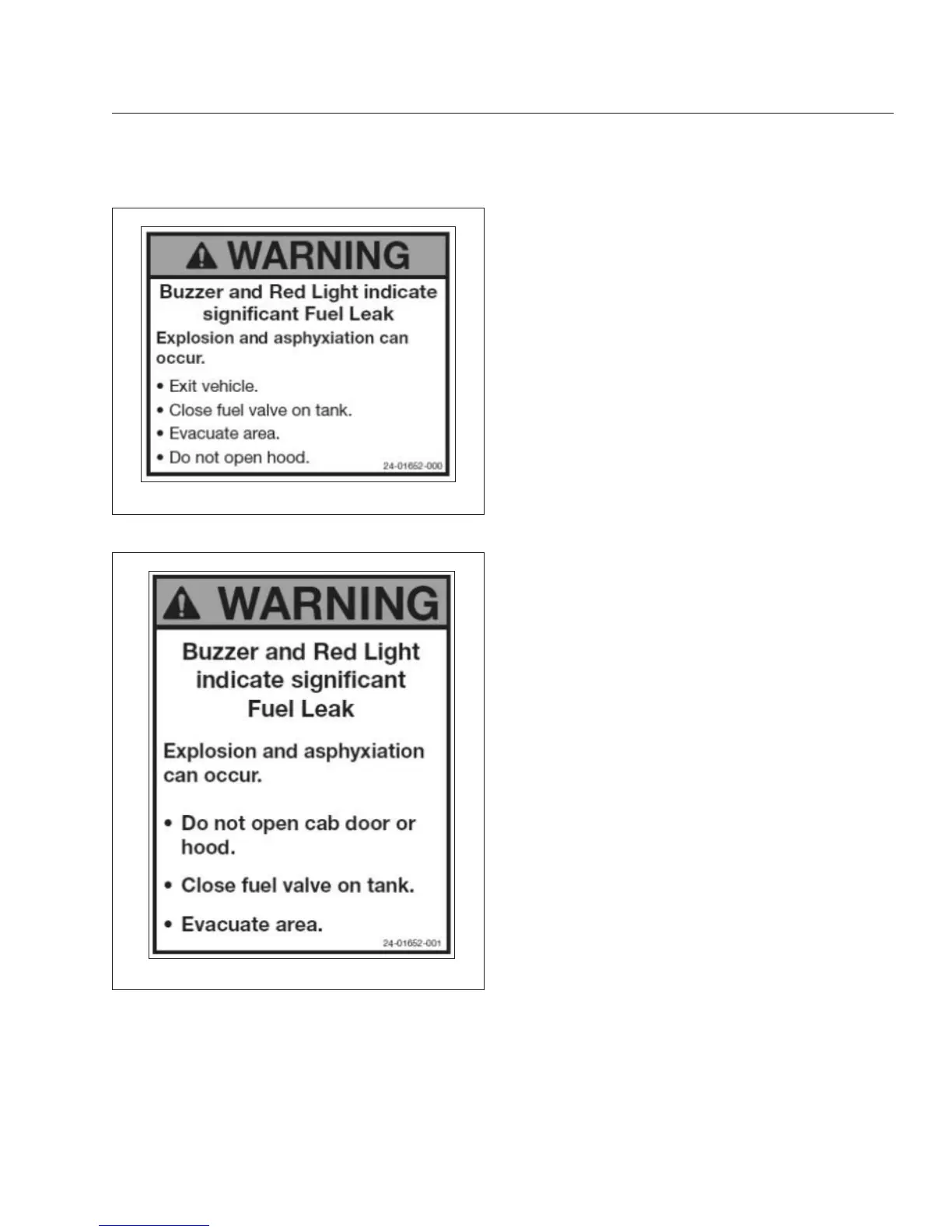
1.
Immediately shut off all engines. Extinguish any
cigarettes, pilot lights, flames, or other sources of
ignition in the area and adjacent areas.
2.
Exit the vehicle leaving as many doors and win-
dows open as possible, and move at least 30
feet away from vehicle. If the vehicle is parked,
stay at lease 30 feet away until it is safe to do
the following.
3.
Manually close all fuel shutoff valves, including
those on the LNG tank or CNG cylinders.
4.
If the vehicle is indoors (as in a service shop),
immediately open shop windows and doors to
provide extra ventilation to the area. Do not start
the engine or any other type of equipment until
the gas leak is corrected and the area cleared of
natural gas.
5.
Evacuate the area.
6.
After the area is cleared of natural gas and the
alarm is no longer active, have the vehicle in-
spected by a qualified technician.
IMPORTANT: Do not consider the area clear
until all alarm indicators are off, and the alarm
panel light returns to green.
Sensors
Gas detection sensors are located on the cab over-
head console (zone 1), in the engine compartment
on the frontwall (zone 2), and in the sleeper, if
equipped (zone 3). The sensors are located in high
areas, where rising gas vapors will pass by or accu-
mulate. On some vehicles, there is a sensor located
under the cab floor (zone 4). Zone 4 is not used on
DTNA vehicles.
If the system detects that one of the sensors has
been disconnected or has malfunctioned, the sensor
fault light for that zone will illuminate. A failed sensor
may trigger and lock on an alarm. If this happens
have a qualified technician troubleshoot the system
and make appropriate repairs.
The sensors are sensitive to all hydrocarbon vapors.
An alarm may be triggered by the use of chemicals
such as cleaners, paint, polish, lacquer, gasoline,
silicone, silicone spray, or other harsh chemicals.
The sensors will also detect hydrogen fumes from an
overcharged battery. If a sensor sends an alarm, but
no gas fumes are present, check for recent use of
chemicals or a battery charger.
04/28/2009 f080157
Fig. 25.4, Interior Warning Sticker
04/28/2009 f080158
Fig. 25.5, Exterior Warning Sticker
Natural Gas Vehicles
25.6











 To Next Page