S90-010 M FRICK
QUANTUM™ COMPRESSOR CONTROL PANEL
Page 30 MAINTENANCE
In order to properly measure the DC power, it must be
checked at the Quantum™ controller, and verified for
acceptable total voltage drop at the end of the daisychain
(last I/O board). For the +5 Vdc (on either power supply), if
the voltage at the Quantum™ is in the range of +5.04 to
+5.08 (+5.06 is ideal), and the voltage being read at the
last I/O board is greater than +4.98 V, it can be assumed
that the +5 V power is correctly adjusted. For the +12 Vdc
(on either power supply), if the range at the last I/O board
is between +11.8 and +12.2 Vdc (+12.00 is ideal), it can
be assumed that the +12 V power is correct. The range for
this voltage is not critical at the Quantum™, and the
reading does not need to be taken there. Remember that
the +12 Vdc cannot be adjusted on the Condor.
CAUTION! Measuring and adjusting the power supply
voltages require the control power switch to be energized.
Extreme care must be observed when taking any
readings, as 120 or 230 VAC (depending on incoming
system voltage) is present within the power supply.
Adjusting the supply requires the use of a small
screwdriver with an insulated shaft, refer to NS-10-02)
inserted into the supply to access an adjusting
potentiometer. It is possible for the screwdriver (and the
person making the adjustment) to come into contact with
potentially lethal voltages.
To perform measurements and adjustments on the power
supply voltages, use a reliable Digital Volt Meter (DVM).
The DVM should be accurate to 1/100 of a volt DC. With
the control power switch turned "ON", wait until the
"Operating Screen" appears. This is because the graphics
required to create this screen will draw more current than
when the screen is showing the normal "POST" style
messages during a boot up. If the screen never appears
however (possibly due to a voltage problem), you will need
to proceed regardless of what is or is not displayed.
Ensure that the meter is set to the proper range (DC, 0-50
V or equivalent), as well as observing proper wire polarity.
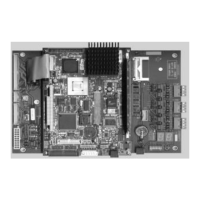
Measure the +5 Vdc first. If you have a Quantum™ 3
controller, refer to the pictorial drawing of it on the
following page for the exact location of the measurement
point. Place the negative lead on the common (return) pin,
and the positive lead on the +5 Vdc pin as shown. Verify
that the DVM is displaying in the range of +5.04 to +5.08
(+5.06 is ideal). If the reading is outside of this range, then
using a thin, flat bladed screwdriver, insert the tip into the
access hole for the appropriate voltage potentiometer
(refer to the Quantum™ Panel D.C. Power Supply
Layouts). While watching the DVM, slowly rotate the
screwdriver blade clockwise to increase the voltage or
counter-clockwise to decrease. Once the voltage has been
adjusted, remove the DVM probes from the Quantum™,
and install them into the white connector on the last I/O
board in the daisychain, as shown below:
Check the reading on the DVM. If the reading at the
Quantum™ has been adjusted properly, then this reading
can be no lower than +4.98 DC. If the voltage is less,
check all of the daisychain connections on the blue DC-I/O
harness. Ensure that all of its connectors are tight. If all
connections are good, then go back and start measuring
over again, this time beginning at the first board in the
daisychain. Continue checking the voltage at each
connection, until you locate the point at which the voltage
drop is excessive. This will usually indicate a connection
that is not being made properly, or the sockets within the
connector are weak. In either case, the DC-I/O wire
harness may need replacing.
Next, you will want to measure the +12 Vdc. Perform the
same steps as with the +5 Vdc measurement, with the
exception that you will not need to measure at the
Quantum™. Measure directly at the last connection. If the
voltage is low, ensure that there is not an excessive
voltage drop in the daisychain. If there is not excessive
loss, and the power supply is a Power One, then it can be
adjusted (refer to the Quantum™ Panel D.C. Power
Supply Layouts for adjustment location). If you have the
Condor, then the supply itself may need replaced.
The -12 Vdc may be measured the same as the other
voltages, however, this voltage is not adjustable on any
supply, so if the harness is not the culprit, the supply may
need to be replaced.
REPLACEMENT
Power One - If you have the Power One supply, and
it is found to be bad, or not capable of acceptable
adjustment, it will need replacing. Since the Power
One is no longer available from Frick
, an upgrade kit
can be ordered that will adapt the Condor supply to
the Power One mounting holes. Refer to the
Recommended Spare Parts list for the upgrade part
number. This upgrade kit will include the following
components:
• Tie wrap wire ties
• Adhesive backed tie wrap mounts
• Screws (6-32 x 3/8 flat head)
• Power supply (Condor)
• Mounting plate (adapts Condor to Power
One mounting holes)
• AC power cable harness (needed since the
Power One supply utilizes screw terminals,
and the Condor utilizes connectors)
• DC power cable harness (needed since the
Power One supply utilizes screw terminals,
and the Condor utilizes connectors)
Condor - If you have the Condor power supply, and it
is found to be bad, or not capable of acceptable
adjustment, it will need replacing. When ordering this
replacement, you will receive an upgrade kit. The
purpose of this kit is to allow for the upgrading of the
I/O DC power harness, at the same time as replacing
the power supply. Refer to the Recommended Spare
Parts list for the upgrade part number. This upgrade
kit will include the following components:
• Screws (6-32 x 3/8 flat head)
• Power supply (Condor)
• DC power cable harness (this is an improved
version of the previous power cable)



 To Next Page