DATA EXCHANGE
D485 MODBUS TO DEVICENET CONVERTER – USER GUIDE 3–5
Protocol configuration
DESCRIPTION In order to be able to communicate on the Modbus sub-network, the D485 must be
supplied with a description of the required sub-net protocol. To accomplish this, the
EnerVista P485/D485 Setup software features a flexible protocol-programming system,
allowing the D485 to interpret and exchange data with almost any serial device on the
Modbus sub-network.
COMMUNICATION MODE The D485 supports the Modbus Master communication mode. In this mode, the D485 is
setup to use the Modbus RTU protocol and implements a Modbus master for data
exchange between the fieldbus and one or more devices on the sub-network. Refer to
Chapter 5 for additional details.
PROTOCOL BUILDING
BLOCKS
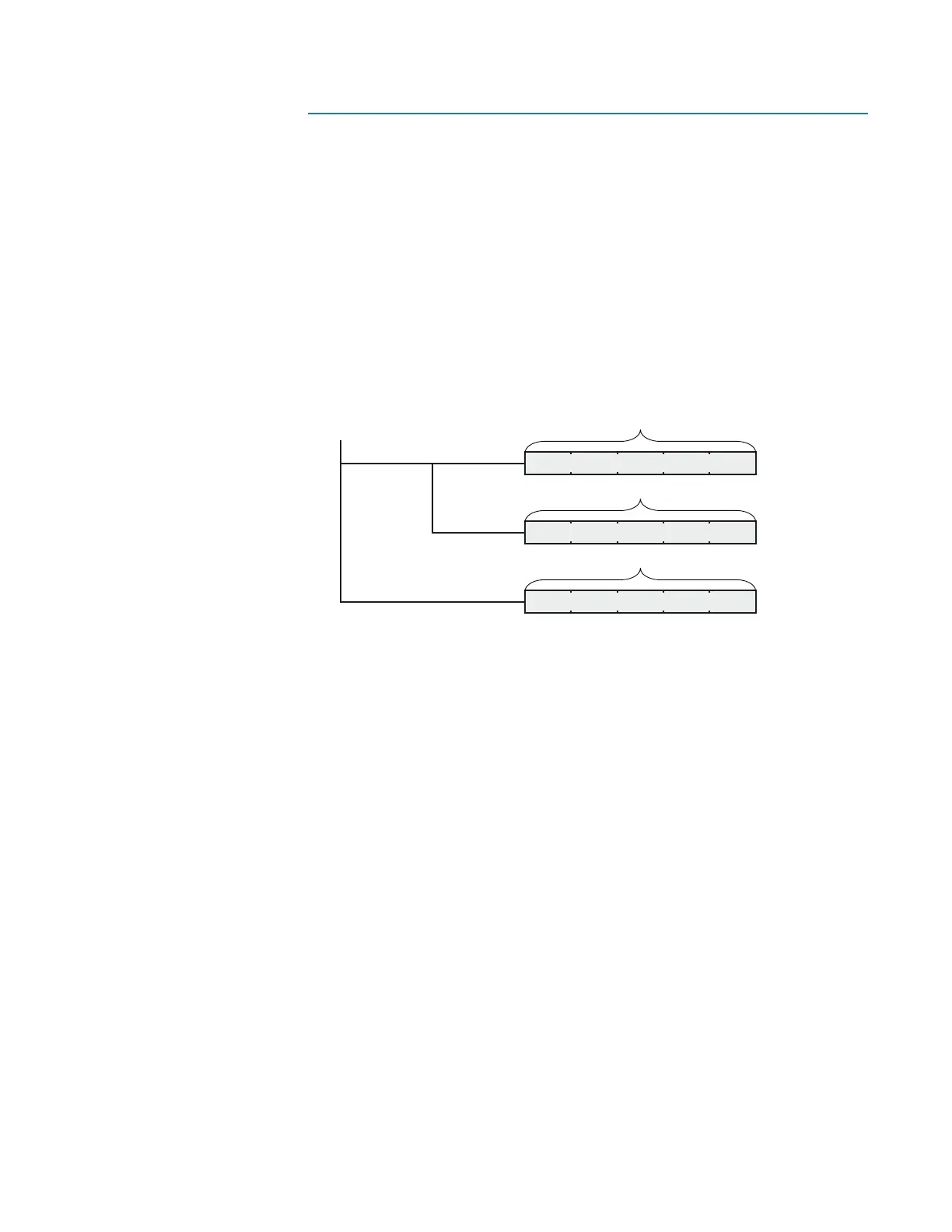
A description of the building blocks used to describe the sub-net protocol is shown below.
Figure 3-5: Modbus protocol blocks
• Node: In the D485, a node holds all transactions and parameters for a particular
device on the sub network.
• Transaction: Transactions contains messages to be transmitted on the sub-network.
A transaction consists of one or more message frames (see figure above), and has a
few general parameters to specify how and when the transaction should be used on
the sub-network.
• Commands: A command is a pre-defined transaction that has been stored in a list in
the EnerVista P485/D485 Setup software. This improves readability as well as
simplifying common operations by allowing transactions to be stored and reused.
• Message frame: The message frame contains a description of what is actually
transmitted on the sub-network and consists of frame objects (see figure above).
• Frame object: Frame objects are used to compose a message frame. Frame objects
include fixed values, dynamic values retrieved from a specified memory location in
the D485, or strings.
Node
Transaction
Transaction
Message frame
Byte
Word Data CRC Byte
Frame objects
Message frame
Byte Word Data CRC Byte
Frame objects
Message frame
Byte
Word Data CRC Byte
Frame objects



 To Next Page