
 Need help?
Do you have a question about the GEA EL48 and is the answer not in the manual?
Explains manual scope, provides manufacturer contacts, and customer service information.
Covers declaration of conformity and general/specific equipment warranties with terms and exclusions.
Outlines the owner's responsibilities for safe operation and environment.
Explains safety symbols and provides fundamental safety guidelines for operating the equipment.
Defines requirements for personnel and details safety parts like guards.
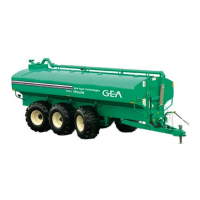
Describes the intended use of the spreader and its main components.
Provides dimensions, weight, load capacity, and tire specifications in imperial and metric units.
Lists tractor requirements, performance data, and hydraulic hose specifications.
Lists torque values for bolts and specifies lubricants for various components.
Requires qualified operators and outlines safety instructions for handling.
Guides on packing material disposal and lists tools needed for handling and assembly.
Provides warnings and instructions for lifting the spreader using lifting rings and support stands.
Details air valve removal, arms assembly, weight transfer, translucent hoses, and knuckle installation.
Covers hub assembly, brake parts installation, and calibration.
Details installing air brake parts, drum, dust shields, and calibrating the system.
Covers checking tire pressure, lifting wheels, and refers to tire specifications.
Refers to maintenance section for adjusting hydraulic suspension for transport.
Explains assembling anti-siphon mechanisms and top fill indicators.
Details assembly of optional PowerHitch, self-loading system, and fenders.
Guides on assembling optional mudguards, nursing kits, and ladders.
Describes assembly of hydraulic door, hopper, and rear lights.
Details assembly of top and bottom spreading nozzles, with or without directional valve.
Covers assembly of various tool bars including disc injectors, deflectors, and gauge wheels.
States that commissioning requires trained personnel and adherence to safety instructions.
Explains power steering setup and provides a comprehensive commissioning checklist.
Lists final checks and the process for handing over the product and warranty.
Requires qualified personnel and outlines safety instructions for operating the spreader.
Lists checks before operation and procedures for connecting PTO driveline and spreader.
Covers testing lights, brakes, and safe procedures for moving the spreader.
Details spreading methods with different tool bars and operating optional features like self-loading.
Guides on safely disconnecting PTO driveline, hydraulic, pneumatic hoses, and electrical outlet.
Describes unhitching procedures for single/double hitch, ball hitch, and PowerHitch.
States that troubleshooting requires trained personnel and adherence to safety.
Provides a table of symptoms, causes, and solutions for spreading, braking, and steering issues.
Requires trained personnel and outlines safety instructions for maintenance tasks.
Provides maintenance schedule and details lubrication for hitch, steering, bearings, and knuckles.
Covers changing brake parts, calibrating systems, adjusting suspension, and power steering.
Lists part numbers and quantities for shear bolts replacement.
States that decommissioning requires qualified personnel and adherence to safety.
Guides on cleaning, lubricating, and storing the product for temporary decommissioning.
Instructs on proper disposal of components according to local rules and regulations.
Illustrates the location of various safety and lubrication labels on the spreader.
Provides pneumatic and hydraulic circuit diagrams for braking, power steering, and optional systems.
Includes the wiring diagram for signal lights and the procedure for testing manure consistency.
Details how to calculate spreading rate and adjust flow rate based on various parameters.

 To Next Page
 General