1.1.2. Connect the product
It is highly recommended that you notice the serial number (written on identication ►
stamp), the localization and a short description for the product. The table in You can
use the table in Appendix F – Additional documents
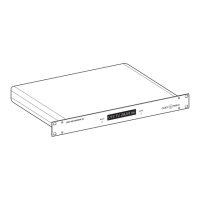
Connect the synchronization outputs to your equipment (see Appendix A – Connec- ►
tions for more information).
Connect the LEDI Network IN to your network using the network cable. ►
Connect the LEDI Network IN to a power supply using the power supply cable when ►
it is present.
Your system should work immediately if you use Gorgy Timing NTP server(s) and there
is a DHCP server on your network. After a 2 minutes learning stage, the LEDI Network
IN activates its outputs and begin to delivers UTC time.
However, Gorgy Timing recommends you to ll-in for each product its physical locali-
zation. This is possible using the GTNetMng tool localized on the CD-ROM. For more
information, see part 31.2.
1.2. SET-UP YOUR PRODUCT
2.1.1. Manual network conguration
Gorgy Timing NTP products are congured in factory to automatically get an IP address.
Two mechanisms are used:
1.
If a DHCP server is present on your network, our products get an address automa-
tically. This ensures that the IP address is compatible with your network.
2. If no DHCP server is present, the product automatically takes an IP address using
the AutoIP mechanism. In this case, the address is in the range 169.254.x.y (whe-
re x and y are in the 0…255 range).If both server and client have started in this
mode, they should work correctly together but their IP addresses may be incom-
patible with other devices on the network.
1
1/ For example, you may not have the possibility to congure the LEDI Network IN from a WEB navigator
1. INTRODUCTION


 To Next Page