24
H4D
on the battery. This is the normal mode when transporting or
storing the camera or where there might be a risk of inadver-
tently activating the camera. (However, remove the batteries if
you are going to store the camera for a period of more than a
few weeks).
In this mode neither the viewnder display nor grip display infor-
mation is available.
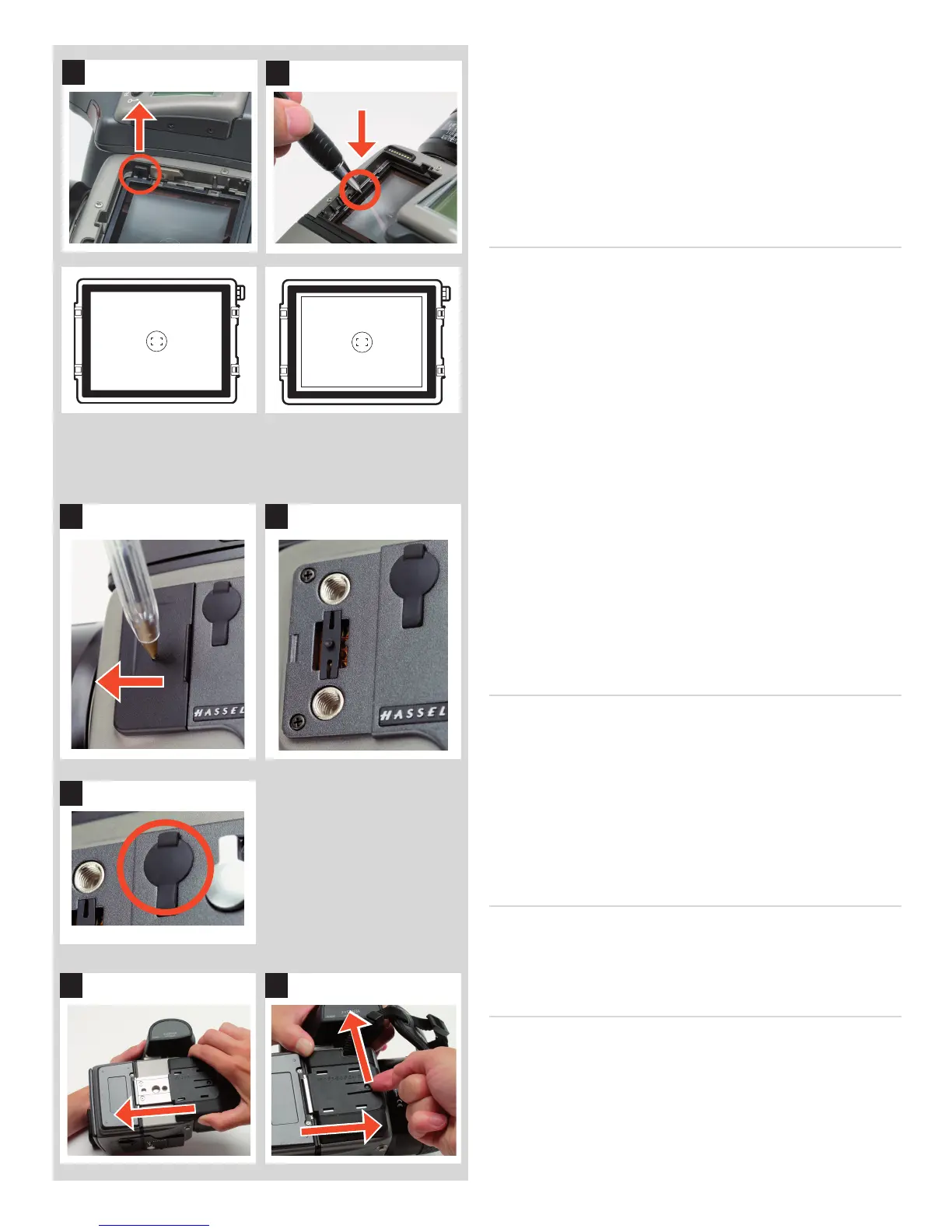
Viewnderscreen 16,17
The H4D is tted with a Spherical Acute-Matte D viewnder screen
for extreme brightness, clarity and even illumination. An optional
accessory screen with a grid pattern is also available.
To change a viewnder screen, remove the viewnder to access
the viewnder screen. To remove the screen, place the tip of a
ballpoint pen or similar in the viewnder screen removal lug and
pull upwards. To replace the screen, position the right side of the
screen in place so that it sits correctly in the recess. Place the tip
of a ballpoint pen or similar in the viewnder screen replacement
indentation and press downwards until the screen snaps into po-
sition. Try to avoid touching either surface of the screen with bare
ngers.
Do not attempt to clean the screen by immersing it in water, or
use any kind of cleaning uid. If the screen becomes damp, do
not use hot air to dry it. Use a soft cloth on the upper surface
only. Seek advice from an Authorized Hasselblad Service Center
if the screen becomes particularly soiled. Remember that parti-
cles or greasy marks on the screen might impair the viewnder
image but have no eect whatsoever on the recorded image.
Accessoryconnection 18,19
On the left hand side of the camera body are two accessory-re-
taining screw threads (M5), as well as a databus connector, pro-
tected beneath a cover.
The cover can be removed by inserting a pointed object, such
as a pen, in the small hole and then sliding it to the left, as in the
illustration. The cover-retaining clip can then also be removed to
access the connector.
PC-connector 20
A PC connector for non TTL-ash synchronisation is located on
the left side of the body. It is protected by a captive rubber plug.
Protective base plate 21, 22
To attach the protective base plate, slip it over the camera foot
until it stops. To remove it, lift the securing catch while pushing
the plate back as in the illustration.
1918
20
2221
17
16
Viewnder screen showing
composition frame marking
(50MPix).
Viewnder screen showing
composition frame marking
(40MPix).





 To Next Page