Chapter 3 Sequencing
Introduction 12
Sequencing Workflow 13
Prepare the Reagent Cartridge 13
Prepare the Flow Cell 14
Prepare Libraries for Sequencing 15
Set Up a Sequencing Run 15
Monitor Run Progress 21
Automatic Post-Run Wash 23
Introduction
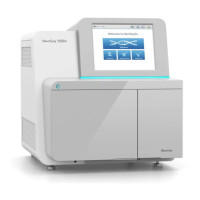
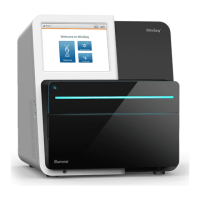
To perform a sequencing run on the NextSeq 500, prepare a reagent cartridge and flow cell, and then follow
the software prompts to set up and start the run. Cluster generation and sequencing are performed on-
instrument. After the run, an instrument wash begins automatically using components already loaded on the
instrument.
Cluster Generation
During cluster generation, single DNA molecules are bound to the surface of the flow cell, and then amplified
to form clusters.
Sequencing
Clusters are imaged using 2-channel sequencing chemistry and filter combinations specific to each of the
fluorescently labeled chain terminators. After imaging of a tile on the flow cell is complete, the next tile is
imaged. The process is repeated for each cycle of sequencing. Following image analysis, the software
performs base calling, filtering, and quality scoring.
Monitor run progress and statistics from the control software interface, from the Run tab on BaseSpace, or
from a networked computer using the Sequencing Analysis Viewer (SAV) software. See
Sequencing Analysis
Viewer
on page 22.
Analysis
As the run progresses, the control software automatically transfers base call (BCL) files to BaseSpace or the
specified output location for secondary analysis.
Several analysis methods are available depending on your application. For more information, see the
BaseSpace help (help.basespace.illumina.com)
.
Sequencing Run Duration
Sequencing run duration depends on the number of cycles performed. The maximum run length is a paired-
end run of 150 cycles each read (2 x 150), plus up to 8 cycles each for 2 index reads.
For expected durations and other system specifications, visit the NextSeq 500 specifications page on the
Illumina website.
Number of Cycles in a Read
In a sequencing run, the number of cycles performed in a read is 1 more cycle than the number of cycles
analyzed. For example, a paired-end 150-cycle run performs reads of 151-cycles (2 × 151) for a total of 302
cycles. At the end of the run, 2 x 150 cycles are analyzed. The extra cycle is required for phasing and
Document # 15046563 v04
For Research Use Only. Not for use in diagnostic procedures.
12


 To Next Page