Need help?
Do you have a question about the Intellian v100GX and is the answer not in the manual?
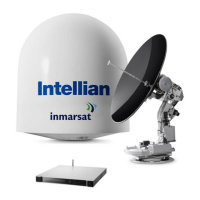
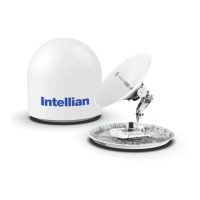
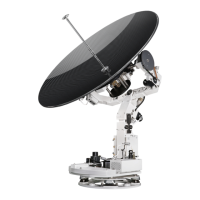
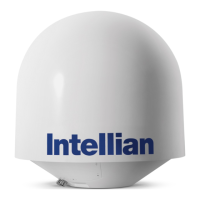
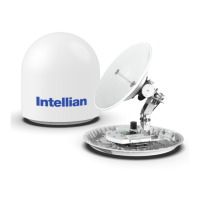
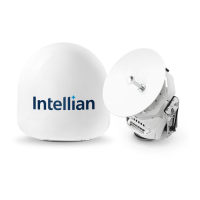
Overview of the Intellian v100GX Ku-to-Ka convertible VSAT maritime antenna system.
Details the key features and capabilities of the Intellian v100GX antenna system.
Diagrams illustrating the basic and dual system configurations for the antenna.
Details the components included in the Intellian v100GX system package.
Guidance on selecting an installation site and configuring radiation hazard zones.
Lists the necessary tools for installing the Intellian v100GX antenna system.
Step-by-step instructions for unpacking and installing the antenna unit.
Provides physical dimensions for the Intellian v100GX antenna unit.
Diagrams showing mounting hole patterns for antenna installation.
Instructions on how to correctly position the radome on the support pedestal.
Details on how to secure the radome base to the support pedestal.
Guidance on making RF cable connections during installation.
Diagram showing cable connections within the power switch box.
Instructions on how to secure RF cables using tie wraps.
Methods for mounting the ACU, including 19” Rack Mount and Table Mount types.
Provides the physical dimensions of the Antenna Control Unit (ACU).
Guidelines for selecting a suitable installation location for the ACU.
How to connect the system to a ship's gyrocompass for heading input.
Using Intellian's Gyro-Free satellite search function when no gyrocompass is connected.
Establishing data communication between a PC and the ACU via TCP/IP or Serial.
Connecting the PC to the ACU via serial port or USB port.
Steps for setting up a WiFi connection to access the ACU wirelessly.
Details the pin assignments for ACU console and RS232/422 connectors.
Overview of ACU setup functions and modes within the manual.
Description of ACU front panel keys and touch key functions.
Describes the ACU's normal operating sequence and status display.
Displays and explains current antenna status, search, and tracking information.
Instructions for entering and navigating the ACU's setup mode.
Initial setup of satellite, latitude, longitude, and gyro type.
Manual satellite search, LNB pol angle, and search parameter adjustments.
Adjusting the LNB polarization angle for optimal signal reception.
Setting search wait time, increment step, and search ranges (1 & 3).
Configuring DVB and NBD detect/tracking levels, and BOW/EL adjust.
Programming up to 5 radiation hazard or blockage zones.
Performing full or single diagnostic tests and interpreting results.
Loading, editing, and adding satellite information to the system.
Editing satellite orbit position, longitude, and name.
Adding new satellite details including DVB verify method and skew offset.
Verifying the Network ID (NID) of the current tracking transponder.
Configuring LNB local oscillator frequency, location, and modem port.
Setting the LNB local oscillator frequency for each voltage power.
Setting ship's gyro type, baud rate, latitude, longitude, and heading.
Configuring modem interface, port, protocol, and modem type.
Backup/restore user data, upgrade firmware, copy logs, and manage system settings.
Enabling keypad lock and setting a password for setup mode access.
Overview of Intellian's Aptus® PC controller software and its requirements.
Step-by-step guide for installing the Aptus software on a PC.
Establishing communication between PC and ACU via Serial or Network.
Steps for connecting ACU via Serial or Network communication.
Description of the functions available in the Aptus software toolbar.
Overview of the dashboard displaying antenna status and system information.
Explanation of the different work view tabs for managing antenna and satellite configuration.
Detailed antenna info: Tilt Sensor Bias, Conical Range, EL Adjust, Rate Sensor.
Displays satellite information, tracking data, and LNB settings.
Visualizing signal, elevation, and azimuth data through graphs.
Monitoring all data received from the ACU, including tracking and debug logs.
Performing antenna diagnostic tests and configuring ACU/Modem interface.
Graphical representation of antenna position relative to target satellite or blockage.
Arranging and managing work view tabs, including layout formatting and zoom tools.
Overview of remote monitoring, control, and diagnostics via TCP/IP protocol.
Logging into the Web M&C interface and selecting control modes.
Description of the main menus and items displayed after login.
Quick monitoring of antenna status, GPS, heading, and product information.
Configuring ship settings, GPS, bow offset, heading, and blockage zones.
Setting antenna position, search/tracking parameters, and sensor adjustments.
Configuring tracking mode, frequency, satellite, DVB/NBD information.
Configuring modem interface, port, protocol, GPS out, and TX mute.
Executing antenna diagnostic tests and viewing results.
Managing satellite library information, loading, editing, and saving.
Upgrading antenna and ACU firmware, managing service packs.
Procedures for upgrading antenna and ACU firmware versions.
Displaying and downloading antenna log data and firmware upgrade logs.
Backing up and restoring antenna configuration to ACU/PC.
Configuring wireless, network, serial, SNMP, and user management settings.
Configuring ACU's internal IP, Ethernet, Management Port, and network services.
Configuring Serial Port 1 for communication with external modems via Ethernet.
Configuring Serial Port 2 for communication with PC control via Ethernet.
Configuring SNMP settings, V1/V2/V3 attributes, trap server, and notifications.
Changing login ID and password for Web M&C access.
Upgrading E2S firmware and service packs for Ethernet-to-Serial module.
Saving settings to ACU and rebooting the system, or rebooting without saving.
Displaying user's log information including date/time, login ID, and IP.
Details regulatory approvals such as CE and FCC compliance.
Physical dimensions and weight of the satellite antenna and control unit.
Specifications for Tx/Rx frequency, gain, polarization, G/T, and range.
Details on ACU display, interfaces, and power consumption.
 General
| Frequency Band | Ku-band / Ka-band |
|---|---|
| Antenna Gain (Ku-band, Tx) | 38.5 dBi |
| Tracking Accuracy | 0.2° RMS |
| Power Consumption | 200W (Typical) |
| Type | VSAT Antenna |
| Antenna Diameter | 100 cm |
| Polarization | Linear, Circular |
| Azimuth Range | 360 degrees |
| Elevation Range | 0 to 90 degrees |
| Operating Temperature | -30°C to +55°C |
| Storage Temperature | -40°C to +70°C |
| Input Power | 100-240 VAC, 50/60 Hz |
| Tracking | Auto tracking |
| Stabilization | 3-axis |
| Compliance | CE, FCC |

 To Next Page