Introduction
Power over Ethernet (PoE) provides a device the capability to transmit both data and
electric power over a copper Ethernet LAN cable.
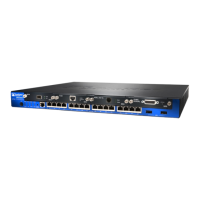
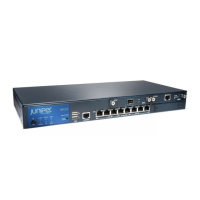
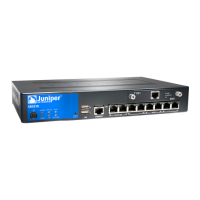
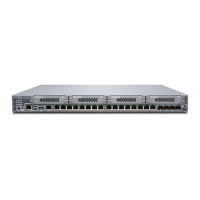
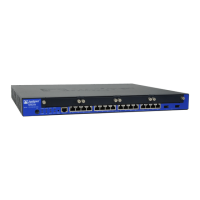
The PoE-capable models of the SRX240 Services Gateway (see SRX240 Services Gateway
Models) PoE on all Gigabit Ethernet ports. The PoE ports transfer electrical power and
data, to remote devices over a standard twisted-pair cable in an Ethernet network. PoE
ports allow you to plug in devices that require both network connectivity and electric
power, such as wireless LAN access points, and VoIP telephones.
You can configure the services gateway to act as power sourcing equipment for devices
connected to the PoE ports.
Table 4 on page 6 lists the PoE specifications for SRX240 Services Gateway.
Table 4: SRX240 Services Gateway PoE Specifications
ValuesPower Management Schemes
•
IEEE 802.3 AF
•
IEEE 802.3 AT (PoE+)
•
Legacy (pre-standards)
Supported standards
PoE is supported on all 16 Gigabit Ethernet ports (0/0
through 0/15; interfaces ge-0/0/0 through ge-0/0/15)
Supported ports
150 wattsTotal PoE power sourcing capacity
30 watts
NOTE: Default value is 15.4 watts
Per port power limit
•
Static: Power allocated for each interface can be
configured.
•
Class: Power allocated for interfaces is decided on the
basis of class of powered device connected.
Power management modes
PoE Classes and Power Ratings
A powered device is classified on the basis of the maximum power that it draws across
all input voltages and operational modes. When class-based power management mode
is configured on the services gateway, power is allocated taking into account the maximum
power ratings defined for the different classes of devices.
Table 5 on page 6 lists the classes and their power ratings as specified by the IEEE 802.3
AF standard.
Table 5: PoE Classes and Power Ratings
Minimum Power Level Output from PoE PortClass
15.4 watts0
Copyright © 2015, Juniper Networks, Inc.6
SRX240 Services Gateway Hardware Guide


 To Next Page
 Loading...