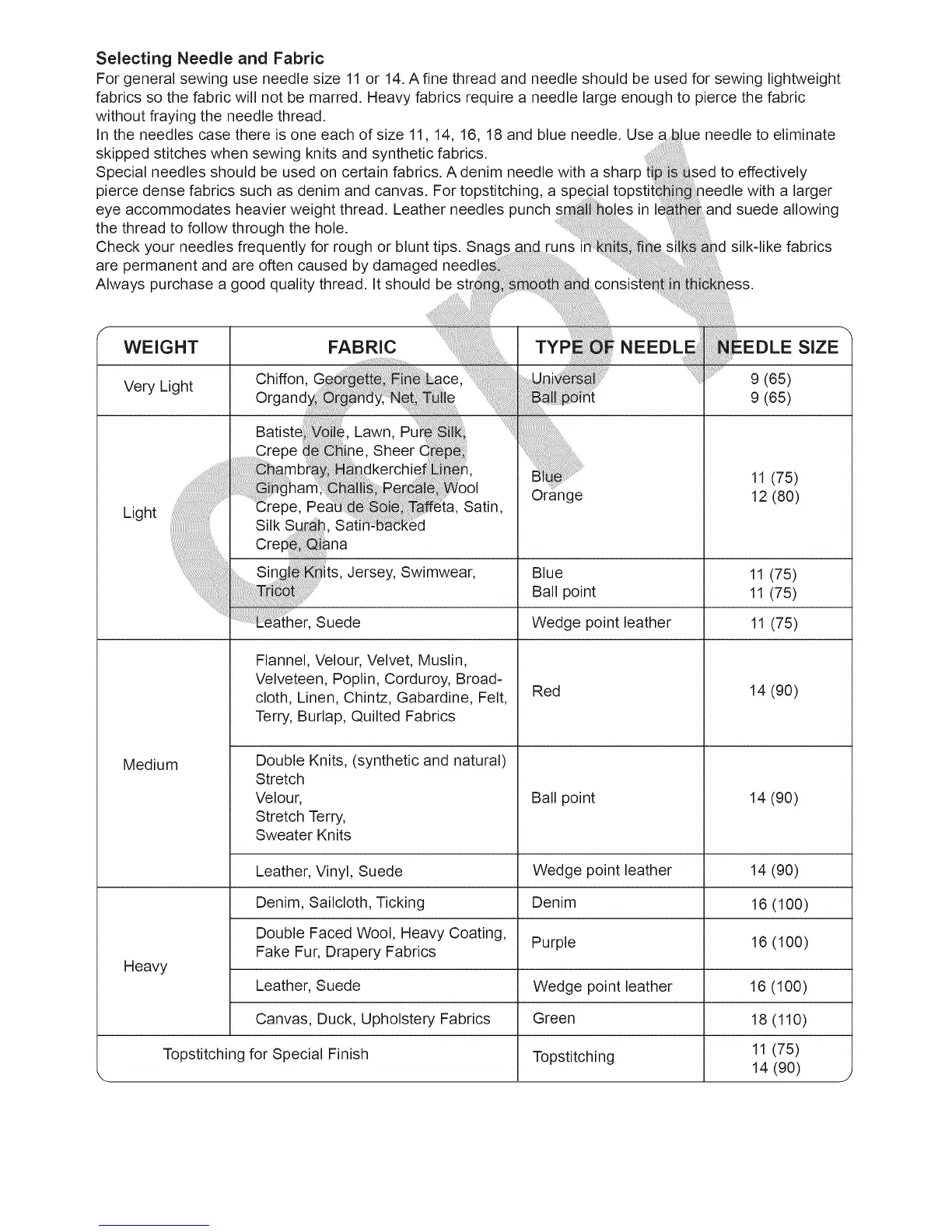
Selecting Needle and Fabric
For general sewing use needle size 11 or 14. Afine thread and needle should be used for sewing lightweight
fabrics so the fabric will not be marred. Heavy fabrics require a needle large enough to pierce the fabric
without fraying the needle thread.
In the needles case there is one each of size 11, 14, 16, 18 and blue needle. Use lue needle to eliminate
skipped stitches when sewing knits and synthetic fabrics.
Special needles should be used on certain fabrics. A denim needle with a shar to effectively
pierce dense fabrics such as denim and canvas. For topstitching, a with a larger
eye accommodates heavier weight thread. Leather needles punch and suede allowing
the thread to follow through the hole.
Check your needles frequently for rough or blunt tips. Snags and runs d silk-like fabrics
are permanent and are often caused by damaged needl(
Always purchase a good quality thread. It should be
WEIGHT FABRIC
Very Light
Light
Medium
Batiste ii_ Lawn Pure
...........Crepe_ _ he, Sheer
hamb_ _ndkerchie_ _,
i ......_repe, Pe_ i:_i ia, Satin,
Silk Su_h S
Crep i_na
.... Singi:: : its, Jersey, Swimwear,
' Eeather, Suede
Flannel, Velour, Velvet, Muslin,
Velveteen, Poplin, Corduroy, Broad-
cloth, Linen, Chintz, Gabardine, Felt,
Terry, Burlap, Quilted Fabrics
Double Knits, (synthetic and natural)
Stretch
Velour,
Stretch Terry,
Sweater Knits
TYP_ _ NEEDLE _EEDLE SIZE
Orange
Blue
Ball point
Wedge point leather
9 (65)
9 (65)
11 (75)
12 (80)
11 (75)
11 (75)
11 (75)
14 (90)
Red
14 (90)Ball point
Leather, Vinyl, Suede Wedge point leather 14 (90)
Denim, Sailcloth, Ticking Denim 16 (100)
Double Faced Wool, Heavy Coating, Purple 16 (100)
Fake Fur, Drapery Fabrics
Heavy
Leather, Suede Wedge point leather
Canvas, Duck, Upholstery Fabrics Green
Topstitching for Special Finish
Topstitching
16 (100)
18 (110)
11 (75)
14 (90)
J



 To Next Page