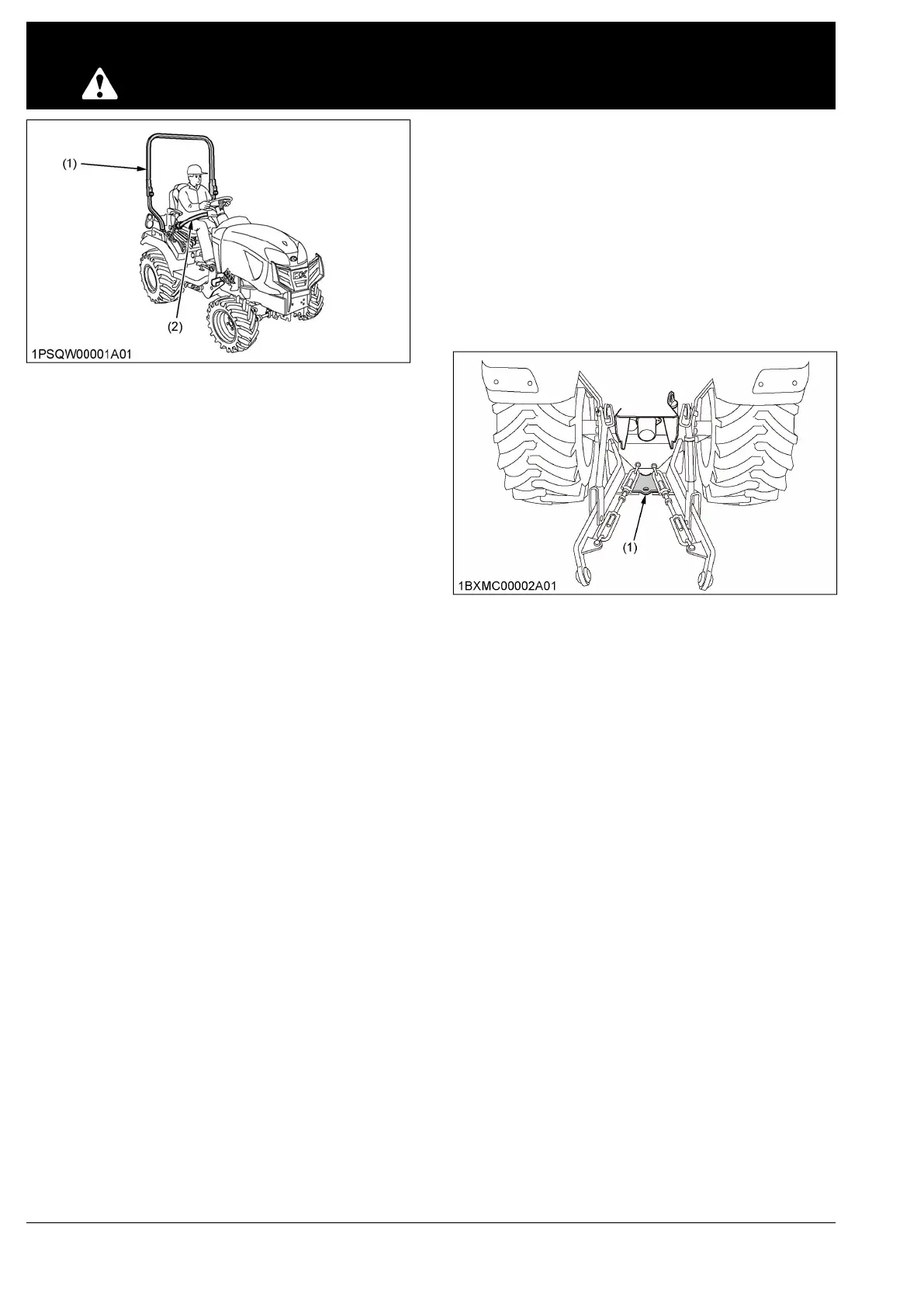
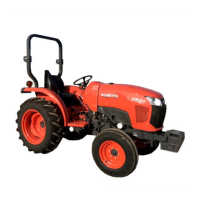
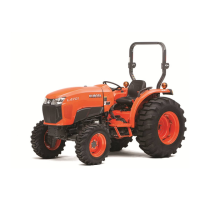
(1) ROPS (2) Seat belt
2. Precautions for operating the
tractor
Operator safety is a priority. Safe operation, specifically
with respect to overturning hazards, entails
understanding the equipment and environmental
conditions at the time of use. Some prohibited uses
which can affect overturning hazards include traveling
and turning with implements and loads carried too high,
and so on.
This manual sets forth some of the obvious risks, but
the list of risks is not exhaustive, and the list of risks
cannot be exhaustive. It is the operator's responsibility
to be alert for any equipment or environmental
condition that could compromise safe operation.
2.1 Precautions for starting to operate the
tractor
• Always sit in the operator's seat when starting the
engine or operating the levers or controls. Adjust
the operator's seat referring to 1. Operator's seat on
page 48. Never start the engine while you are
standing on the ground.
• Before starting the engine, make sure that all levers
including auxiliary control levers are in their neutral
positions, that the parking brake is engaged, and
that the power take-off (PTO) is disengaged or off.
Fasten the seat belt if the tractor is equipped with a
CAB, a fixed ROPS, or a foldable ROPS in the
upright and locked position.
• Do not start the engine by shorting across starter
terminals or bypassing the safety start switch. The
tractor may start in gear and move if normal starting
circuitry is bypassed.
• Do not operate or idle the engine in a non-
ventilated area. Carbon monoxide gas is colorless,
odorless, and deadly.
• Check that the operator-presence-control-system
(OPC) are functioning correctly before each time
you use the tractor. Test safety systems. See
2. Checking the engine start system on page 123
and 3. Checking the OPC (operator presence
control) system on page 124.
Do not operate unless they are functioning
correctly.
2.2 Precautions for working the tractor
• Pull only from the hitch. Never hitch to the axle
housing or any other point except the hitch.
Hitching to the axle housing or any other point
except the hitch will increase the risk of serious
personal injury or death due to a tractor upset.
(1) Hitch
• Keep all shields and guards in place. Replace any
shield or guard that are missing or damaged.
• Avoid sudden starts. To avoid upsets, slow down
when turning, on uneven ground, and before
stopping.
• The tractor cannot turn with the differential locked.
Do not turn with the differential locked as it could be
dangerous.
• Do not operate the tractor near ditches, holes,
embankments, or other ground surface features
which may collapse under the weight of the tractor.
The risk of tractor upset is even higher when the
ground is loose or wet. Tall grass can hide
obstacles, so walk the area first to be sure.
• Watch where you are going at all times. Watch for
and avoid obstacles. Be alert at row ends, near
trees, and other obstructions.
• When working in groups, always let the others
know what you are going to perform before you
perform it.
• Never try to get on or off a moving tractor.
• Always sit in the operator's seat when you are
operating levers or controls.
• Do not stand between the tractor and the
implement or trailed vehicle unless parking brake is
applied.
• Do not operate or tow the tractor at speeds
exceeding specific travel speed.


 To Next Page