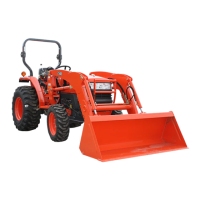
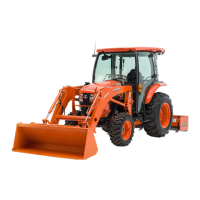
(1) Frame (2) Jack point
BALLAST
WARNING
To avoid serious injury or death:
• You will need the additional ballast for
transporting the heavy implements. When the
implement is raised, drive slowly over rough
ground, regardless of how much ballast is used.
• Do not fill the front wheels with liquid to
maintain steering control.
NOTE :
• The ballast is not required when doing the
normal operations with the BX23S tractor, the
LA340 loader, and the BT603 backhoe
connected in factory settings.
1. Front ballast
IMPORTANT :
• Do not overload tires.
• Add no more weight than indicated in the
following table.
Maximum weight
125 kg
(275 bs.)
Add weights if needed to improve traction or for
stability. Heavy pulling and heavy rear mounted
implements tend to lift front wheels. Add enough ballast
to maintain steering control and prevent tip over.
Remove weight when no longer needed.
2. Rear ballast
Add weight to rear wheels if needed to improve traction
or for stability. The amount of rear ballast should be
matched to job and the ballast should be removed
when it is not needed.
When the loader is attached on the tractor and the
backhoe is not attached on it, you should install the
rear wheel weight (option) to the tractor.
Liquid ballast in rear tires
You should add the weight to the tractor in the form of
liquid ballast.
Water and calcium chloride solution provides safe
economical ballast. Using the liquid ballast properly will
prevent tires, tubes, or rims from damaging. The
addition of calcium chloride is recommended to prevent
the water from freezing. The addition of calcium
chloride for weighting the wheels has the full approval
of the tire companies. See your tire dealer for this
service.
Liquid weight per tire (75 percent filled)
Tire sizes 26x12.00-12
Slush free at -10 ℃ (14 ℉)
Solid at -30 ℃ (-22 ℉)
[Approx. 1 kg (2 lbs.) CaCl2 per 4 L (1 gal) of
water]
45 kg
(99 lbs.)
Slush free at -24 ℃ (-11 ℉)
Solid at -47 ℃ (-52 ℉)
[Approx. 1.5 kg (3.5 lbs.) CaCl2 per 4 L (1 gal)
of water]
50 kg
(110 lbs.)
Slush free at -47 ℃ (-52 ℉)
Solid at -52 ℃ (-62 ℉)
[Approx. 2.25 kg (5 lbs.) CaCl2 per 4 L (1 gal)
of water]
56 kg
(123 lbs.)
IMPORTANT :
• Do not fill tires with water or solution more than
the correct percentage of full capacity as shown
in the following table to the level of valve stem
at the 12 o'clock position.
(1) Air
(2) Water
(3) Valve stem
(A) Correct
(B) Incorrect
Correct Incorrect
Amount of water
75% of full capacity
of tire
100% of full capacity
of tire
Characteristic
Air compresses like
a cushion
Water can not be
compressed
BALLAST TIRES, WHEELS, AND BALLAST


 To Next Page