42
Animal or human victim: The shape of the curves (sine curve) will depend on the person, their
position, the depth, etc. Fundamentally, the animal breathing curve will be the same shape as for
humans, but could have different frequencies, for example the breathing frequency of a dog is
usually 25-30 breaths per minute, but for humans it generally does not exceed 15-20 breaths per
minute, but in situations of intense stress, this frequency can exceed 20 breaths per minute.
This makes it harder to interpret the curves.
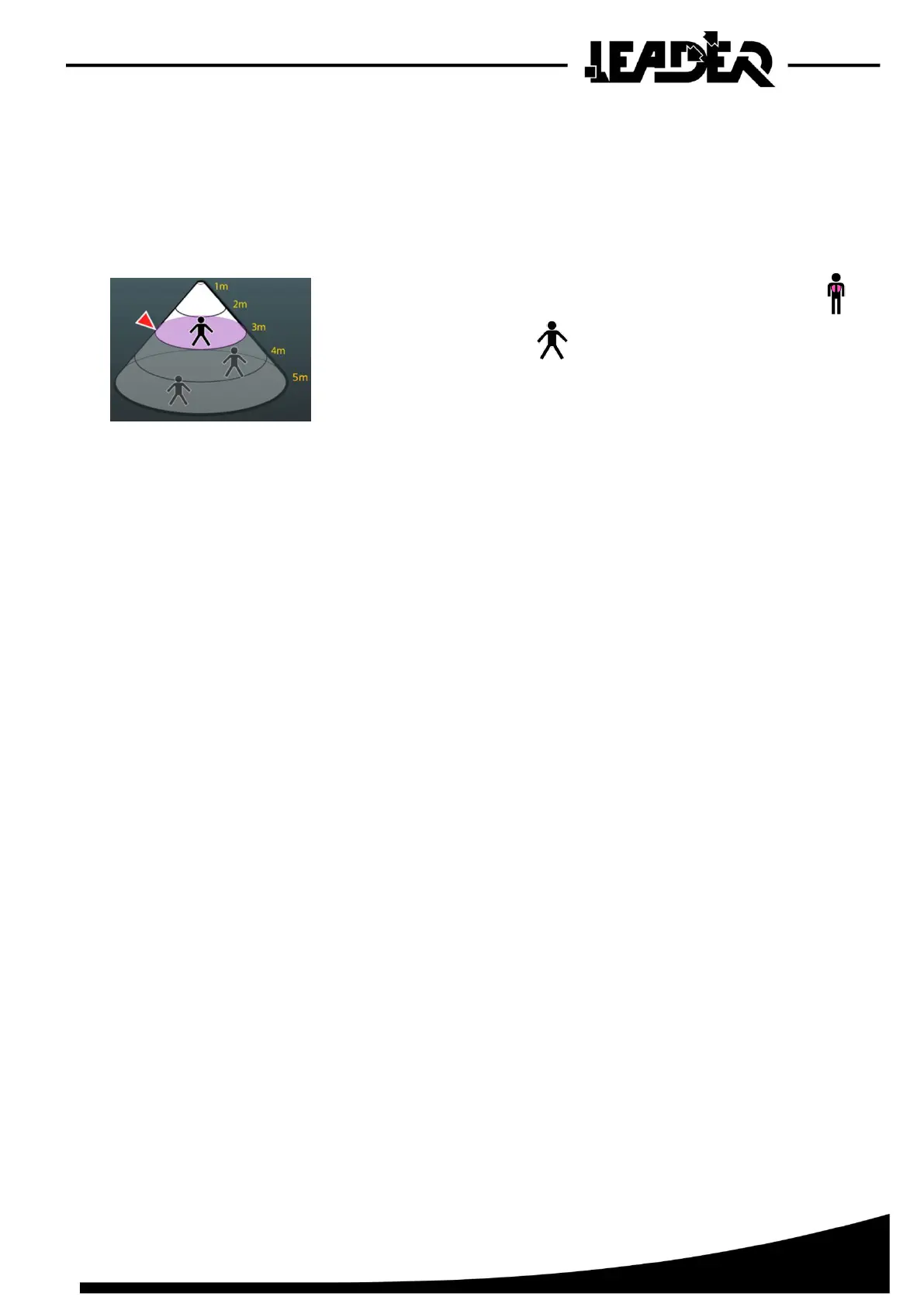
The position of the pointer (red pointer on the cone) at the detected
movement display level appears in the cone (“weak movement” or
“strong movement” icon ), helps display if the oscillogram signal
is stronger. By moving the red points on the cone above and below its
initial position, we note more or less significant variations in sine
curves. With a large sine curve, the user can conclude that
the movement would be at this position.
The pointer therefore helps define the distance at which the movement is detected and therefore
confirm the presence of movements.
The scale of the Y axis adapts to the signal intensity to balance the heights of the curve on
the screen and therefore the movements detected in the field.
The LEADER Scan remains one of several tools used when searching for buried victims.
The emergency worker must understand that they must rely on other search equipment or
knowledge like their experience of collapsed structures to identify potential pockets of life in rubble,
lines used by search dogs, the indexes generated by using search cameras and vibration detectors,
etc.
UWB technology has its limits and, where possible, it must be combined with seismic technology by
using detection of vibration caused by a victim (LEADER Search, for example) and/or using visual
location (using a search camera (LEADER Cam for example)) where holes and recesses allow
insertion.
By summarising all this information using different tools and the opinion of the emergency team,
they will be able to decide if it is necessary to go back over certain area.


 To Next Page