58 59
ENEN
Take care when riding in wet or
windy conditions
Braking power decreases in rainy weather. Even if
brakes are suitably adjusted and regularly serviced,
braking in wet conditions will require more pressure
and stopping distance will be increased.
Grip decreases in humid conditions. The road can
be slippy and objects which appear harmless, such
as dead leaves, zebra crossings and manholes, can
become dangerous. Grip is further decreased when
on frozen, icy surfaces.
Poor weather conditions can cause other issues
when riding. A wet tire may cause the dynamo to
malfunction. Gusts of wind can cause the bike to
turn sharply and unexpectedly, especially if riding
deep rims.
Keep safety in mind when riding
Many cycling accidents could be avoided with a little
common sense and safety consciousness. A few
examples:
• Check the bike before every ride.
• Do not ride “no hands”.
• Do not ride with objects tied to the handlebar or
any other part of the bike.
• Do not ride under the inuence of alcohol or
drugs, or if you are taking medication which could
cause drowsiness.
• Do not carry passengers.
• Do not ride in an aggressive fashion. Respect the
conditions of use of your particular bike.
• Take care when riding off road. Ride only on paths,
and avoid rocks, roots and grooves. Slow when
approaching a descent, move your bodyweight
backward and use the rear brake more than the
front brake.
• Avoid riding in groups which are too large. In a
group, you will inevitably come into close contact
with other cyclists, which can degrease your eld
of vision; you may not see obstacles or dangers on
the road until the last minute, meaning your reaction
time to avoid them in greatly reduced. You risk
losing control of your bicycle if cyclists around you
suddenly change speed or direction. Furthermore,
large groups of cyclists can cause problems for
other road users.
• Do not ride too fast. The greater the speed, the
greater the risks. The risk of wheels slipping or of
damage to the frame or fork caused by uneven
ground increases with speed. A higher speed also
results in more violent impacts in the event of an
accident. Make sure you are in control of your
bicycle at all times.
Make sure you are visible
Your bicycle is equipped with a full set of reectors.
Ensure these are clean and correctly positioned, as
they contribute to your visibility only when light is
directly shone upon them. Reectors do not allow
you to see better ; a good set of lights will help you
in this situation.
If you ride at nightfall, at night or in conditions where
visibility is reduced, consult your retailer for advice
on choosing the most appropriate equipment and
lighting to increase how much you see, and how well
you are seen, in compliance with local regulations.
WARNING : riding in bad or rainy weather
can be difficult. Reduce speed and ride with
even more care than usual, or choose an alternative
means of transport.
WARNING :when riding in low visibility
conditions (fog, at dusk, in the dark), it is
possible that other road users may barely see you,
which could result in a collision or accident.
Use both front and rear lights when riding in low-
light or reduced-visibility conditions.
!
!
Brake with caution
Always maintain a safe distance between yourself
and other vehicles or objects. Adapt the distance and
braking force to the road and weather conditions.
If your bicycle is equipped with two manual
brakes, apply both simultaneously and move your
bodyweight toward the rear of the bike.
The left gear lever operates the front brake, while
the right lever operates the rear brake. To change
this setup, refer to Chapter 3 (page 73).
Many modern brake systems are very powerful.
They are designed to stop a bike in rainy or muddy
conditions. If the brakes are too powerful, visit you
retailer to adjust or replace the braking system.
Changing gears correctly
You can select the gear ratio best adapted to the
riding conditions, ie the speed that allows you to
pedal at a consistent, regular rhythm.
The left shifter operates the front derailleur while
the right shifter operates the rear derailleur. Only
operate one shifter at a time. Change gears only
when the pedals and chain are rotating forward. Do
not change gear when riding over bumps, as the
chain may jump or drop.
When changing gear, reduce the pressure applied
to the pedals. This will decrease the tension and
allow for a quicker and smoother gear change. It
also reduces wear on the chain and gears, and will
avoid bending or damaging the chain, derailleurs
and chainrings.
Avoid « cross-chaining » when riding: if your chain is
on the big chainring and largest cog (or on the small
chainring and smallest cog), it sits diagonally, with
WARNING : the risk of injury increases if you ride your bicycle in inappropriate fashion :
• Jumping with your bike
• Riding on sticks, debris or other obstacles
• Performing acrobatics or stunts with you bike
• Extreme off-road riding
• Riding at high speed on descents or in competition
• Abnormal use of your bike
The examples above are all activities which increase the strain placed on each part of the bicycle. The frame
or any other part could break if these efforts are too great, increasing the risk of injury.
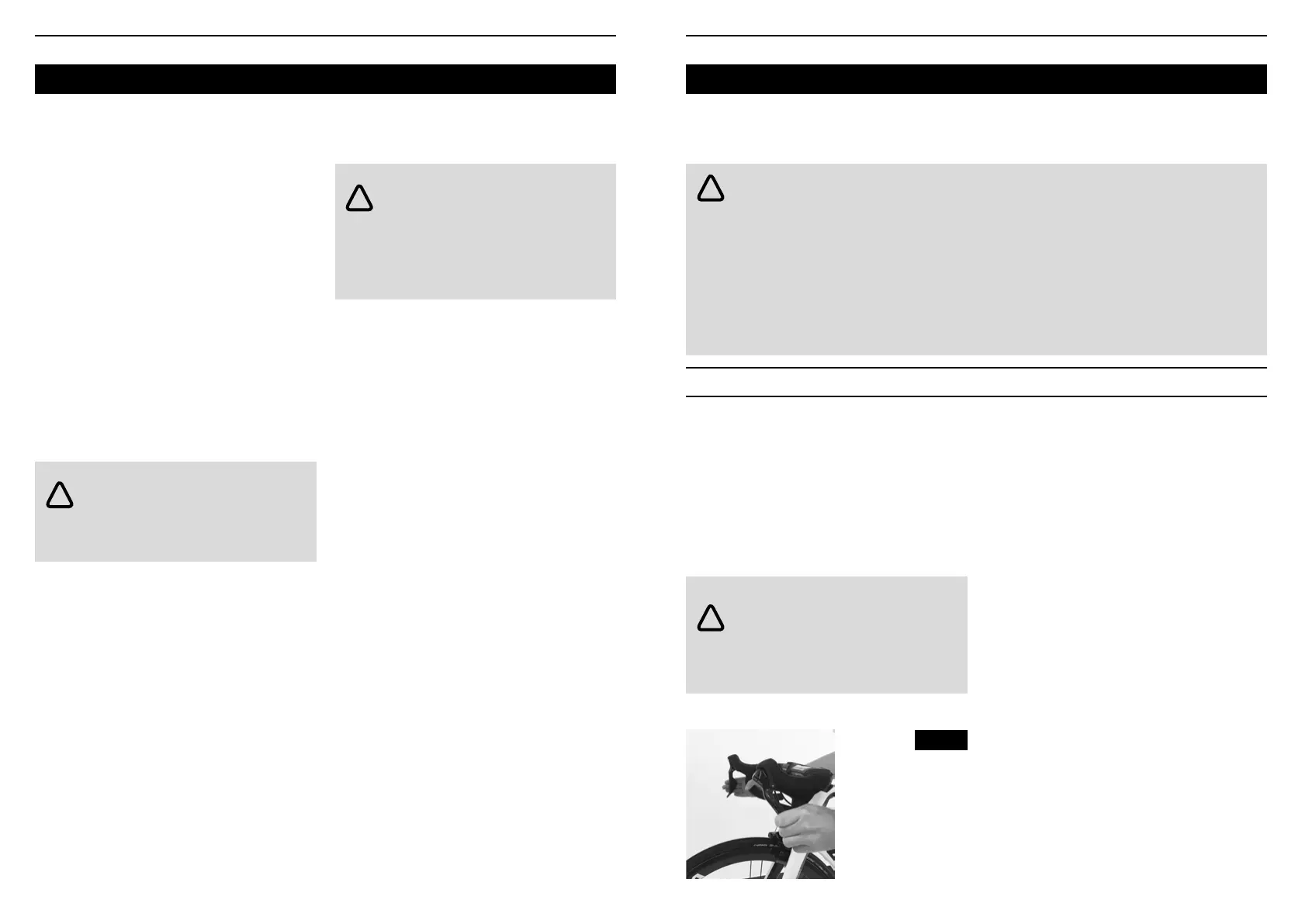
WARNING : excessive or sudden forceful
use of the front brake can cause the rear
wheel to lift, or the front wheel to slide. This could
cause you to lose ontrol and fall (Figure 10).
!
!
RIDING INSTRUCTIONS
Fig. 10
Avoid excessive use
of the front brake :
the rear wheel
could lift and
result in loss of
control.




 To Next Page