80 81
ENEN
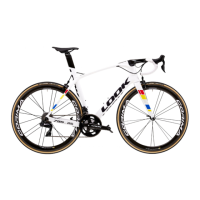
Frame (frame and fork)
The frame is the skeleton of the bike. It is the element
to which the other parts are xed, including the fork.
The fork holds the front wheel and is guided by the
handlebar. Frame maintenance is essential for your
safety. Before attempting any work on the frame or
fork, or attached components, read the WARNING
section on Maintenance on page 49.
Frame materials (steel or aluminum alloys, carbon
ber) can vary from one bicycle to another. If your
bicycle is made from carbon ber, read the Carbon
Fiber Components section on page 55.
Furthermore, frame and fork can have integrated
suspensions. If your bicycle has a suspension, read
the Suspension section in this chapter.
General information
LOOK forks are not compatible with any mechanism
that fastens onto the fork, with the exception of
sensors for bike computers. If you would like to know
if a particular device can be attached to your fork,
ask your retailer for advice.
Carbon ber road bike frames must always be tted
with a seatstay protection to avoid any damage
caused by a dropped or jammed chain.
Excessive heat, such as that used in powder
coating, or open an ame can damage the adhesive
that holds together the parts on some frames. Do
not expose the frame to temperatures above 90°C.
Frames with round or cylindrical seatposts are tted
with one of the three standard seatpost clamps,
which t seatposts with an outer diameter of 27,10 to
27,20 mm, 29,10 to 29,20 mm or 31,40 to 31,60 mm.
The seatpost must be measured before installation
to ensure it meets these standards.
Avoid cleaning frame parts or components with
solvents or corrosive chemicals. Use a soft, damp
cloth and either bike cleaner or a mix of water and
washing up liquid. Using industrial solvents could
corrode or damage not only the paint, but also the
components holding parts of the frame together.
Tolerances for recessed or threaded parts are
critical. Force-tting a part that is either too large
or misaligned may break the frame or the part. If
you tighten a threaded bolt, screw or clamp too far,
you may damage the threads or break the part.
Ensure that all threads are clean and properly
greased before tightening them. Start by turning any
threaded part by hand, not with a wrench.
Stripping a frame requires specic procedures which
should only be carried out in an suitable workshop.
Contact your retailer for further information.
Special frame characteristics
Some bicycles have one or more unique attachment
points that allow the tting of custom accessories.
Before every ride
Before every ride, check the frame and fork carefully
for any potential signs of strain or fatigue. Scratches,
cracks, lumps, deformation or discoloration are all
signs of strain. Any part showing signs of damage,
strain or fatigue must be replaced before using the
bike.
Check the seatstay protection once a month. Ensure
it is correctly tted and secured. If it has moved or is
damaged, ask your retailer to replace it.
Inspect the fork carefully once a year. Detach the
fork from the frame to check the steerer tube and
crown, which are otherwise partly concealed in
the frame. This can be done at the same time as
headset maintenance. As this procedure involves
taking the headset bearings apart, it requires
specic tools and training. If you do not have the
skills and/or tools, it is recommended you visit your
retailer.
Checking the fork
1. Take the fork apart.
2. Carefully clean the steerer tube and crown.
3. Look for any signs of fatigue or damage cause by
impact.
Adjusting metal or composite elements
Carbon or aluminum frames and forks along with
aluminum components such as dropouts are not
as malleable as steel. Never try to adjust a part by
bending or twisting it; it is not possible to readjust
aluminum or composite parts. If the frame is
damaged, take it to your retailer, who will assess it
and decide whether to repair or replace it.
Repairing the frame or fork
Some types of damage can be repaired in our
workshops. In this case, the frame or fork must be
returned via an authorized retailer.
Reectors
Every three months, check that all front, rear, wheel
and pedal reectors are securely attached. Ensure
the front and rear reectors are set at an angle
perpendicular to the ground, and that all reective
surfaces are clean and in good conditions. The front
reector should point directly forward, while the
rear reector should point directly backward. Wheel
reectors must be set tight against the spokes to
avoid any clicking or rattling.










 To Next Page