Instructions SL1 19
1 Make sure that the provisions contained in chapter 1
"WARNINGS" have been carefully observed.
2 Using the selector switch or the radio transmitter, test the opening and
closing of the gate and make sure that the leaves move in the intended
direction.
The test should be carried out a number of times to make sure that the
gate moves smoothly, that there are no points of excessive friction and
that there are no defects in the assembly or adjustments.
3Check the proper operation of all the safety devices, one by one
(photocells, sensitive edges, etc.). In particular, each time a device is
activated the "ECSBus" LED on the control unit flashes for a longer time,
confirming that the control unit recognizes the event.
4To check the photocells and make sure that there is no interference
with other devices, pass a 5 cm diameter, 30 cm long cylinder on the
optical axis, first near TX, then near RX and finally at the mid-point
between them and make sure that in all these cases the device is
triggered, switching from the active to the alarm status and vice-versa;
finally, that it causes the intended action in the control unit, for example
that it causes the reversal of the movement during the closing
manoeuvre.
5 Measure the impact force according to EN 12445 standard. If "motor
force" control is used to assist the system for the reduction of the impact
force, try to find the adjustment that gives the best results.
3.6.2 Selecting the Type of Operating Cycle
The opening and closing of the gate can take place according to different
operating cycles:
•Single cycle (semiautomatic): the gate opens with a command and
stays open until the next command is given, causing it to close.
•Complete cycle (automatic closing): the gate opens with a command
and then closes automatically after a short time (for the time, see
paragraph 5.1.1 "Adjusting the Parameters with the Radio Transmitter").
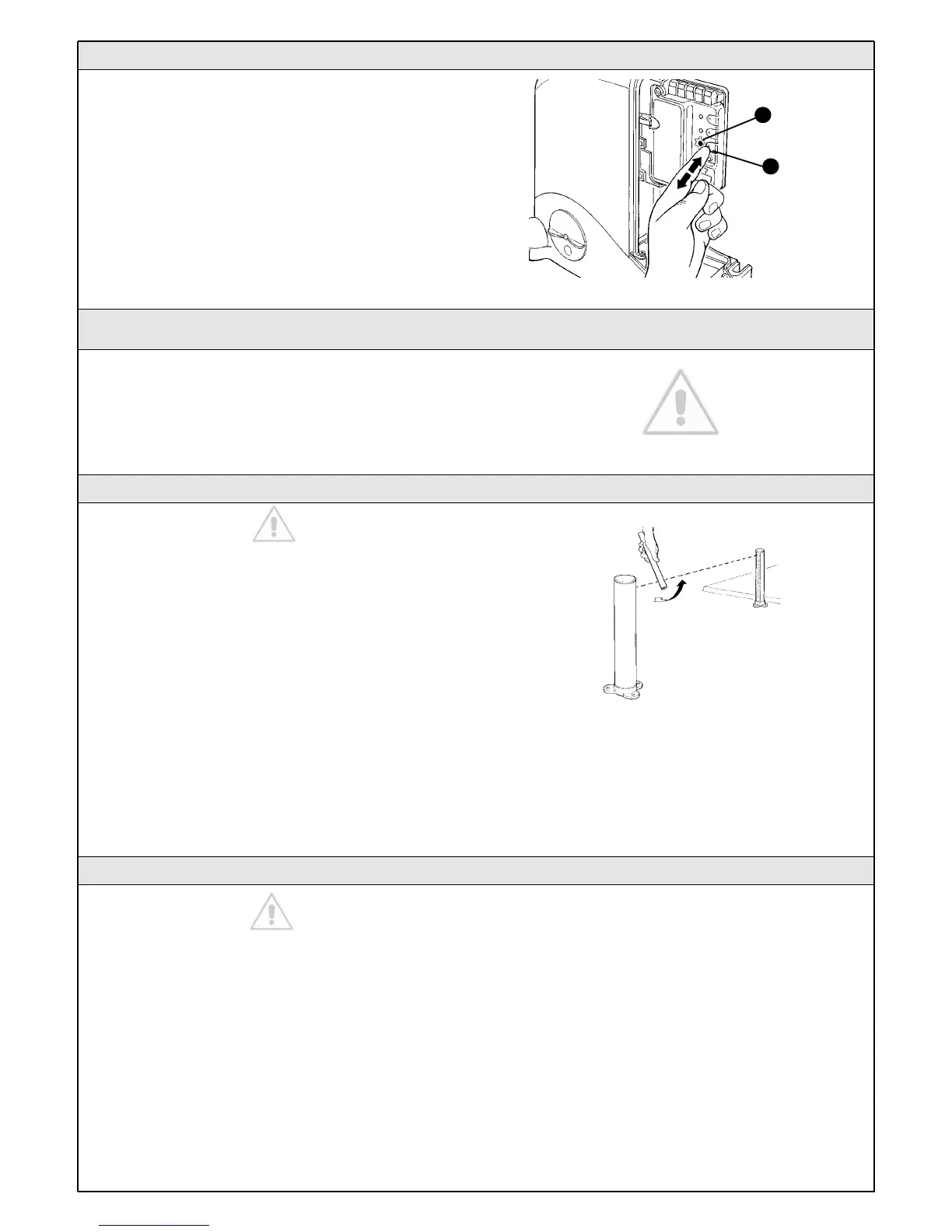
o switch from one operating cycle to the other, press the P3 button [B]
momentarily; the corresponding LED [A] will light up or go off; if the LED
is off the cycle is "single", if the LED is on the cycle is "complete".
Figure 64
3.7 Testing and Commissioning
These are the most important operations, designed to guarantee the
maximum safety and reliability of the automation system.
The testing procedure can also be used as a periodic check of the
devices that make up the automation.
The testing and commissioning operations must be performed by
qualified and experienced personnel who must establish what
tests should be conducted based on the risks involved, and verify
the compliance of the system with applicable regulations,
legislation and standards, in particular with all the provisions of
EN 12445 standard which establishes the test methods for gate
automation systems.
3.7.1 Testing
3.7.2 Commissioning
Figure 65
The commissioning operations can be performed only after all
the tests have been successfully carried out. Partial
commissioning or implementation of "temporary" conditions are
not permitted.
1 Prepare the technical documentation for the automation, which must
include at least: assembly drawing (e.g. figure 1), wiring diagram (e.g.
figure 17), analysis of hazards and solutions adopted, manufacturer's
declaration of conformity of all the devices installed. For SL1 use Annexe
1 "EC Declaration of Conformity of the SL1 components".
2 Post a label on the gate providing at least the following data: type of
automation, name and address of manufacturer (person responsible for
the "commissioning"), serial number, year of manufacture and "CE"
marking.
3Fill out the declaration of conformity and deliver it to the owner of the
automation system; for this purpose you can use Annexe 2 "EC
Declaration of Conformity".
4Prepare the operating guide and deliver it to the owner of the
automation system; Annexe 3 "OPERATING GUIDE" can be used as an
example.
5Prepare the maintenance schedule and deliver it to the owner of the
automation system; it must provide directions regarding the
maintenance of all the automation devices.
6Before commissioning the automation system inform the owner
regarding dangers and hazards that are still existing.
B
A


 To Next Page