© Microhard Systems Inc. 132
6.0 Installation
Fade Margin
When all radio path numbers are being considered and hardware assumptions are being made,
another factor to consider is the ‘fade margin’ of the overall system. The fade margin is the dif-
ference between the anticipated receive signal level and the minimum acceptable receive level
(receive sensitivity). Being that the Pico Series performs to exacting specifications, the overall
deployment should be such that the modems may be utilized to their full potential to provide a
reliable and robust communications link. A typical desired fade margin is in the order of 20dB,
however oftentimes a 10dB fade margin is acceptable.
Frequency
The 900MHz frequency range is not effected by rain to any significant degree, and is also able
to penetrate through foliage and ‘around obstacles’ to a certain degree. This being the case,
some may choose to scrimp on the physical deployment, particularly when it comes to antenna
(tower) heights. Path calculations provide results which specify ‘required’ antenna heights. For
cost savings and in taking advantage of the characteristics of the frequency range, sometimes
the height requirements are not adhered to: this may result in unreliable communications.
Power Requirements
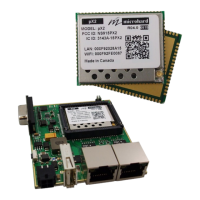
The Pico Series may be integrated into a system (Development Board, or custom) which ac-
cepts a range of DC input voltages (supply current requirements must also be met). In some
deployments, power consumption is critical. A number of features related to minimizing power
consumption are available with the pX2 such the ability to operate at lower transmit power given
the receive sensitivity of the distant modem.
Interference
The frequency hopping spread spectrum (FHSS) operation of the Pico Series most often allows
it to work well in an environment within which there may be sources of in-band interference.
Frequency Restriction (Hopping Zones) is a built-in feature which may be utilized to avoid spe-
cific frequencies or ranges of frequencies; the Spectrum Analyzer function may be used to iden-
tify areas of potential interference. Cavity filters are also available if required: contact Micro-
hard Systems Inc. for further information.


 To Next Page