16
Quality Factor (Q) and Dissipation Factor (D):
Quality factor is used to measure the energy consumed for measuring relative frequency.
Generally speaking, the higher the quality factor of a circuit the better the selectivity is.
Dissipation factor is the reciprocal of quality factor. It refers to the signal angle loss between
the capacitor (or inductor) and the operating frequency under a fixed temperature; the phase
shift generated by the time lag between the external voltage and generated currentcauses loss
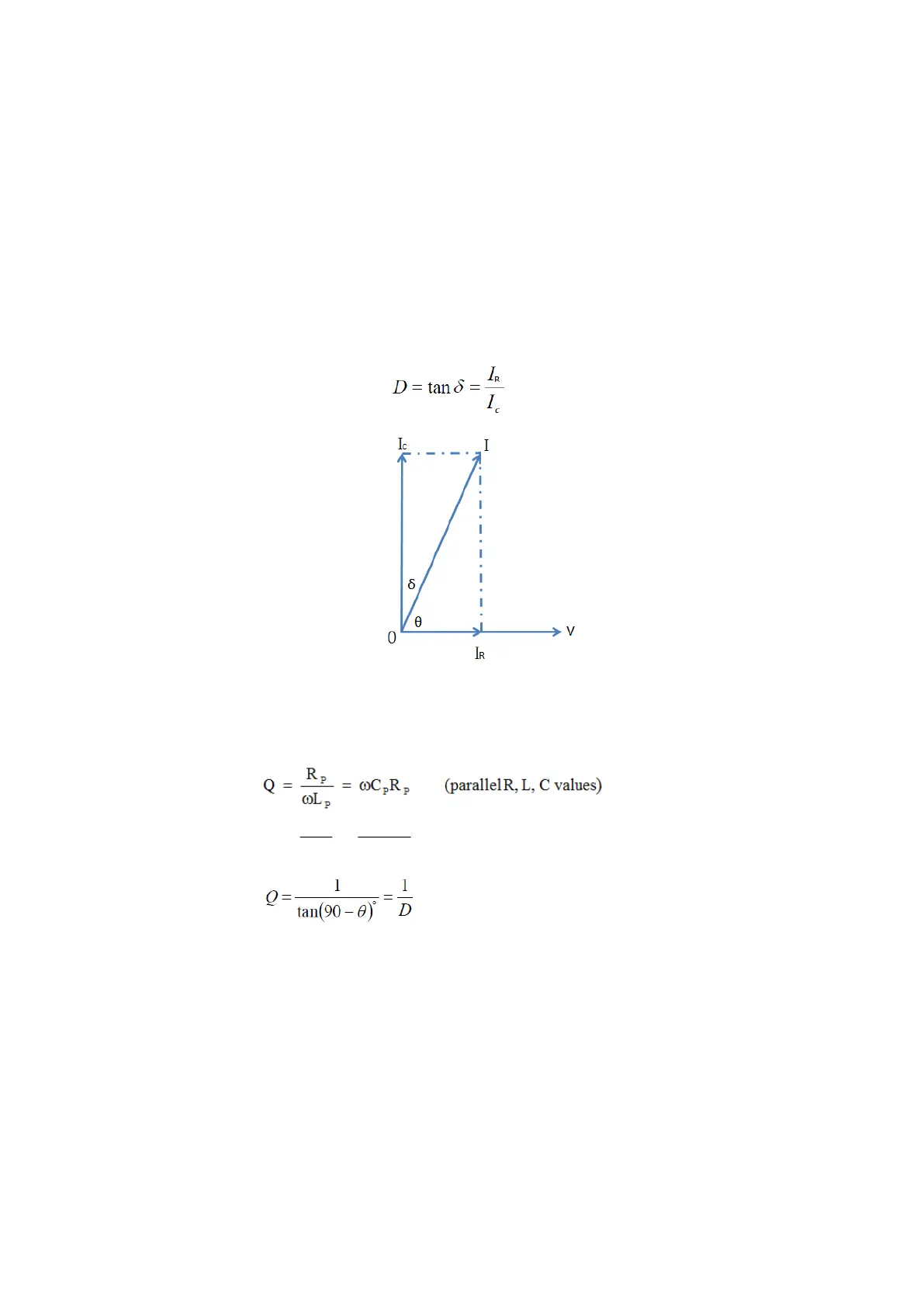
current and energy dissipation, and the current has two compositions at this time. One is the charging
current (lc) that is 90°different from the voltage and the other is the loss current (IR) that is the same
as the voltage; the total current (I) is the sum of the two. The angle δ between the total current
and the charging current is called the Loss Angle , and tanδ is called the Dissipation Factor “D”, as
shown in the figure below:
Figure 2-6-1 Actual Phase Change Figure of the Capacitor
Quality Factor(Q)
Related Formula:


 To Next Page