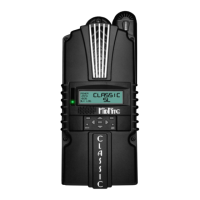
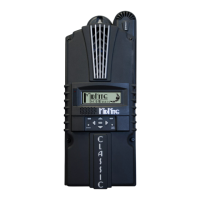
Classic Manual Rev L
14 | P a g e 1 0 - 0 0 1 - 1 R E V L
To Connect Wiring to the Classic:
Ensure the DC source and battery are disconnected.
Connect a grounding conductor between the Classic and system ground.
Ensure the breaker between the battery and Classic meets UL489 standards.
Ensure the breaker between the DC source and Classic meets UL1077 standards.
Use copper building wire ONLY.
Connect the DC source and battery wires to the Classic.
Connect any communications cables or auxiliary input/output wires.
Torque terminal connector setscrews to the following specs:
o Up to #10 AWG: torque at 25- to 35-inch pounds.
o #8 AWG: torque at 30- to 40-inch pounds.
o #6 AWG or larger: torque at 40- to 50-inch pounds.
Diagram 1 Explanations:
10 - Solar modules (PV).
11 - DC combiner (i.e., MidNite MNPV6 or MNPV12).
12 - MNSPD300-DC (Surge protection).
13 - MNSPD300-AC (Surge protection).
14 - MNSPD300-DC (Surge protection).
15 - DC breaker for the inverter (Also serves as a disconnect for the Inverter).
16 - DC breaker for the PV into the Classic (Also serves as a disconnect for the Classic).
17 - DC breaker for the battery into the Classic (Also serves as a disconnect for the Classic).
18 - AC L1 input bus bar (This is where the generator L1 input gets wired).
19 - AC neutral bus bar (This is where ALL AC Neutrals get wired).
20 - AC L1 output bus bar (i.e., L1 output to the load center for the building).
21 - Battery positive bus bar (This is where you wire the battery positive side of the Classic,
as well as where you wire up DC loads. Do NOT wire the battery cable to this bus bar).
22 - Earth ground busbar (This is the common earth ground bus bar where all the grounds
get wired back to and it needs to be connected to the building’s ground rod system).
23 - PV positive bus bar (This is where the solar panels positive lead connects).
24 - Battery negative bus bar (This is where the solar panel negative lead goes as well as the
Classic’s negative lead and any negatives from the loads. Do NOT connect the battery
negative cable to this bus bar.
25 - DC shunt (The shunt measures the amperage in or out of the battery. You connect the
battery to one side and everything else to the other side).
26 - Earth ground system of the building.
27 - Classic charge controller.
28 - AC generator.
29 - Batteries (The voltage must match the voltage of the inverter).
30 - Classic temperature sensor.
31 - DC cables to inverter.


 To Next Page