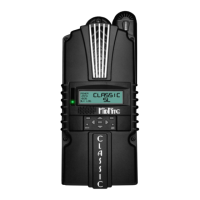
Classic Manual Rev L
7 | P a g e 1 0 - 0 0 1 - 1 R E V L
DC and Battery-Related Installation Requirements
All DC cables must meet local and national codes (Reference NEC Article 480).
Shut off all DC breakers before connecting any wiring.
Torque all Classic wire lugs and ground terminals to the specs found on Page 14.
Copper wire ONLY with a rating of 75° C or higher.
Keep cables close together (e.g., using a tie-wrap) as much as possible to reduce inductance.
Ensure both cables pass through the same knockout and conduit to allow the inductive
currents to cancel.
DC over-current protection must be used on the Classic input and output circuits.
Breakers between the battery and the Classic must meet UL489 standards.
Breakers between the DC source and the Classic must meet UL1077 or UL489 standards.
Design the battery enclosure to prevent accumulation of hydrogen gas at the top of the
enclosure. Vent the battery compartment from the highest point to the outside. A sloped lid
can also be used to direct the flow of hydrogen to the vent opening. Sealed (AGM, Gel)
batteries do not normally require ventilation. Consult your battery manufacturer for details.
WARNING: Personal precautions during installation – Batteries present risk of electrical
shock, burn from high, short circuit current, fire, or explosion from vented
gases. Follow proper precautions.
Someone should be within range of your voice to come to your aid if needed.
Keep plenty of fresh water and soap nearby in case battery acid contacts skin, clothing, or
eyes.
Wear complete eye protection. Avoid touching eyes while working near batteries. Wash your
hands with soap and warm water when done.
If battery acid contacts skin or clothing, wash immediately with soap and water. If acid
enters an eye, immediately flood the eye with running cool water for at least 15 minutes and
seek medical attention.
Baking soda neutralizes lead acid battery electrolyte. Keep a supply on hand in the area of
the batteries.
NEVER smoke or allow a spark or flame in vicinity of a battery or generator.
Be cautious to reduce the risk of dropping a metal tool onto batteries. Doing so can short the
batteries or other electrical parts, resulting in fire or explosion.
Never wear metal rings, bracelets, necklaces, and watches when working with a battery or
other electrical circuits. A battery can produce a short circuit current high enough to weld a
ring or the like to metal, causing severe burns.
How to KILL Your Batteries
Batteries are delicate and require proper attention especially when off-grid. Think of your batteries
and solar equipment as a small nuclear power plant, hydro dam, or natural gas-fired power plant.
Just like any of those, your system needs DAILY attention to ensure it is performing correctly and
safely. For Lithium battery banks we highly recommend using the Logic input on the Classic which
allows the BMS to tell the Classic to stop charging if the BMS detects an issue brewing. We also
recommend the use of an independent battery monitor/alarm if you have an expensive battery
bank. Below is a list of some of the most common ways we have seen people kill their battery bank.


 To Next Page