Classic Manual Rev L
8 | P a g e 1 0 - 0 0 1 - 1 R E V L
Not watching the charge voltages or verifying you are charging to the voltage supplied by the
battery manufacturer.
Not verifying the temperature compensation neutral point (typically 25° C) and the milli volts
per degree C per cell (typically -5mV).
Not watching to verify the Absorb or EQ time is set properly and that the equipment actually
charges for that period of time. Some equipment will have settings like “End Amps” that can
terminate Absorb early and if set up wrong can damage a battery.
Not having enough charge current (Solar Panels) to properly charge the size of the battery
you have. Consult the battery manufacturer for the minimum charge current.
Using tap water or other liquids instead of distilled water in a flooded battery. The minerals
in the tap water will destroy a battery.
Failing to keep all connections clean.
Not using ALL EQUAL LENGTH interconnect cables on each string. It is important that ALL
strings be wired EXACTLY the same. Any variance in resistance on one string versus another
will cause an imbalance and the batteries will be dead in less than 6 months.
Using more than three parallel strings and not using common bus bars. When you use more
than three strings it is very hard to properly charge the middle strings. The only safe way to
do this is to wire each string with equal length cables to a common bus bar.
Not making sure your lead acid batteries get a full charge at least once a week.
Routinely using more than 50% of the capacity of the lead acid battery. Using more than half
the battery capacity drastically shortens the batteries life; occasionally is fine but on a daily
basis will kill them in months.
Not leaving ample space between cells for cooling. We recommend at least one inch between
the cells for cooling. Ask the battery manufacturer what they recommend.
Trusting a State of Charge (SOC) meter, which can lose calibration over time and give you
false readings. You need to verify specific gravity and or verify the charge voltage is being
met. Never fully rely on the SOC %; it is just a good, quick reference.
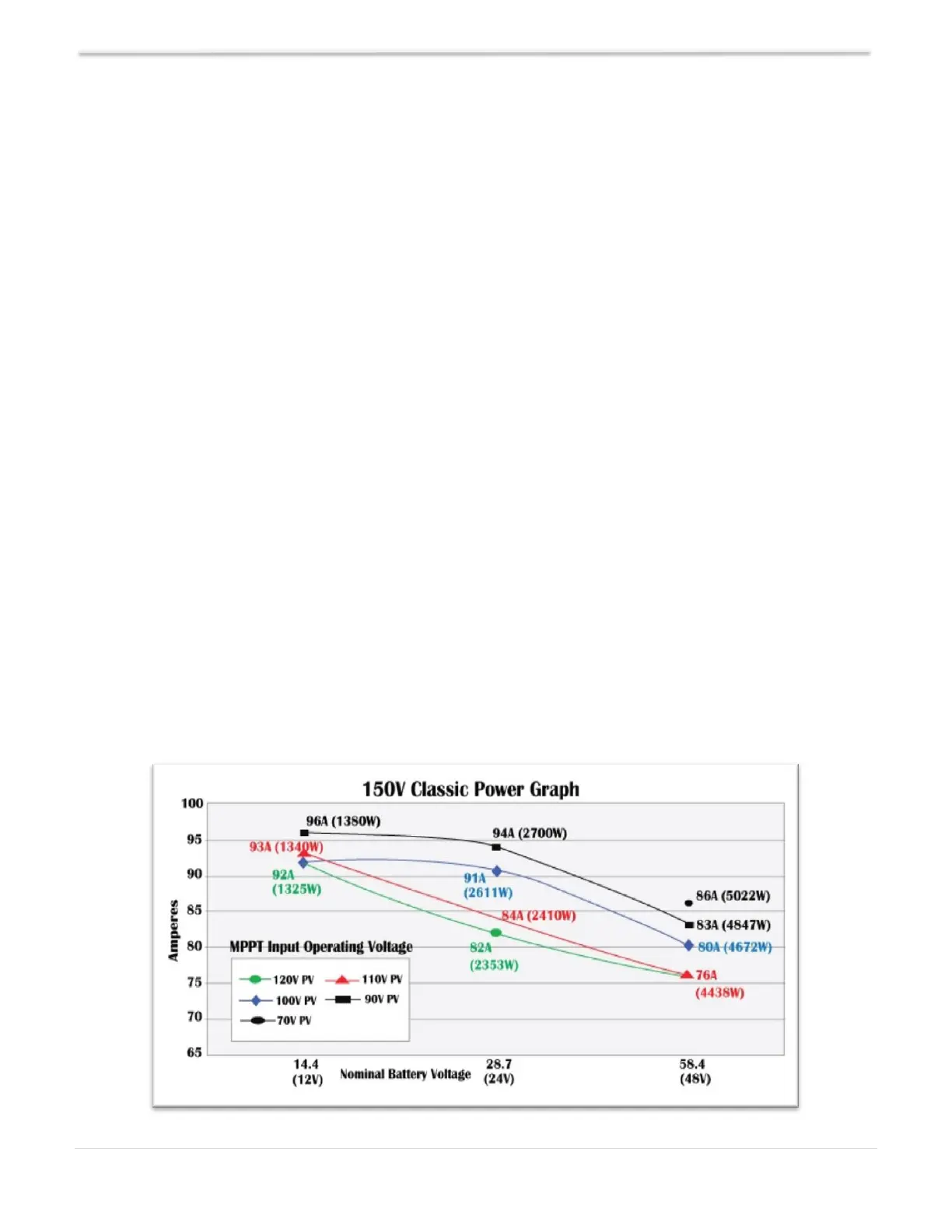
Classic Power Curves
Table 1


 To Next Page