This document describes the Mini-Circuits Multi-Channel Programmable Attenuators, a series of devices designed for precise control of RF signal attenuation in various applications. These attenuators offer multi-channel programmability and support multiple control interfaces, making them versatile for lab, production, and automated test environments.
Function Description
The Mini-Circuits Multi-Channel Programmable Attenuators are designed to provide variable attenuation of RF signals across multiple independent channels. These devices can be controlled via USB, Ethernet (HTTP, Telnet, SSH), or RS232 (for RUDAT models), allowing for flexible integration into different test setups. The attenuators feature a wide attenuation range and fine resolution, making them suitable for applications requiring precise signal level adjustments.
Key functions include:
- Attenuation Control: Users can set specific attenuation levels for each channel independently.
- Sweep Mode: Allows for an automated sequence of attenuation levels, either sequential or with fixed step sizes.
- Hop Mode: Enables a user-defined table of attenuation and dwell times for each channel, allowing for complex signal variations.
- Log Attenuation: Records changes in attenuation levels, providing a log file for analysis and troubleshooting.
- Dynamic Addressing (Daisy-Chain Control): Certain models support connecting multiple attenuators in a master/slave chain, where a single USB connection to the master unit controls all modules. This feature simplifies setups involving numerous attenuators.
- Firmware Update and Recovery: The devices support firmware updates to incorporate new features or bug fixes, and a recovery option is available for corrupted firmware.
Important Technical Specifications
The attenuators come in various models (e.g., RC4DAT-8G-95, RC8DAT-8G-95, RC4DAT-8G-120H, RC4DAT-6G-95, RC4DAT-6G-60, RC4DAT-6G-30), each with specific characteristics:
- Number of Channels: Typically 4 or 8 channels, depending on the model.
- Frequency Range: Varies by model, for example:
- RC8DAT-8G-95: 1-8000 MHz
- RC4DAT-8G-95: 1-8000 MHz
- RC4DAT-8G-120H: 200-8000 MHz
- RC4DAT-6G-95: 1-6000 MHz
- RC4DAT-6G-60: 1-6000 MHz
- RC4DAT-6G-30: 1-6000 MHz
- Attenuation Range: Varies by model, for example:
- RCxDAT-xG-95 models: 95 dB
- RC4DAT-8G-120H: 120 dB
- RC4DAT-6G-60: 63 dB
- RC4DAT-6G-30: 30 dB
- Attenuation Resolution: Typically 0.25 dB or 0.05 dB, depending on the model.
- Max Input Power: Typically +23 dBm or +28 dBm, depending on the model.
- Control Protocols: USB, HTTP, Telnet, SSH (RS232 for RUDAT models).
- Operating Temperature: 0°C to +50°C.
- Humidity: 5% to 85% RH (non-condensing).
- Altitude: Up to 2000 m (6560 ft.).
- Pollution Degree: 2 - Normally only non-conductive pollution occurs (per IEC 61010).
- Switching Time: Typical switching times range from hundreds of nanoseconds (e.g., 200 ns for 120 to 0 dB, 362 ns for 45 to 15 dB).
Usage Features
- User-Friendly GUI: A Windows-based Graphical User Interface (GUI) simplifies manual control and configuration of the attenuators. The GUI allows users to select control modes (USB, Ethernet, Demo), set attenuation levels, configure sweep and hop modes, and manage device settings.
- Multiple Control Interfaces: Support for USB, Ethernet (HTTP, Telnet, SSH), and RS232 (for RUDAT models) ensures compatibility with a wide range of test systems and programming environments.
- API Programming Objects (DLL files): For automated test setups, API programming objects are provided, allowing control via common lab test software.
- Daisy-Chain Control: This feature allows connecting up to 99 units in a master/slave configuration, controlling all modules through a single USB connection to the master unit. This is particularly useful for applications requiring a large number of attenuation channels.
- Dynamic Addressing: Modules in a daisy-chain are automatically assigned addresses (0 for master, 1 to N for slaves) upon connection or refresh, simplifying setup.
- Configuration Settings: Users can configure various settings such as power-up states (last defined attenuation, default attenuation, or max attenuation), device address, and step size for manual attenuation scroll bar.
- Ethernet Configuration: The Ethernet settings screen allows users to configure IP address, subnet mask, gateway, HTTP/Telnet/SSH ports, and login credentials, supporting both DHCP and static IP configurations.
- Safety Precautions: The manual highlights important safety considerations, such as maximum allowed RF input power, and warnings regarding electrical shock and proper grounding.
Maintenance Features
- Firmware Updates: The attenuators support firmware updates to ensure optimal performance, add new features, and address any potential issues. The process involves downloading the firmware file and using a dedicated utility program.
- Firmware Recovery: In cases of corrupted firmware, a recovery option is available. This process guides users through connecting the unit via USB, loading the firmware file, and initiating the upgrade. Different recovery procedures are outlined for legacy and current controller models.
- Service and Calibration: Mini-Circuits recommends periodic service and calibration to maintain accuracy. The devices are designed for easy cleaning with a soft, slightly dampened cloth and alcohol solution.
- Support Contacts: Mini-Circuits provides dedicated support contacts for technical assistance, warranty, RMA returns, and general inquiries, ensuring users can get help when needed.
- End of Life Information: Information regarding product end-of-life and environmentally friendly disposal options is provided.
- Log Attenuation Feature: This feature records all attenuation changes, which can be invaluable for debugging and verifying device operation during maintenance or troubleshooting.

 Need help?
 General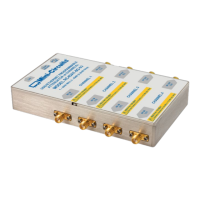

 To Next Page