AN-49-011 © 2023 Mini-Circuits
Rev. D | ECO-016581 | 25-Jan-2023 Page 28
5.4. Operation Modes
The GUI provides the ability to carry out an automated sequence of attenuations settings, either a sequential sweep from a start
value to a stop value, with a fixed step size (increment or decrement) and dwell time, or an arbitrary "hop" sequence of attenuation
and dwell time values.
5.4.1. Sweep Mode
The sweep mode allows each channel to be configured with its own start, stop and step attenuation values for an incrementing
or decrementing sequence. Any combination of the 4 or 8 channels can be configured with a sweep sequence but the same dwell
time will be applied for each channel and step. All included channels will step through their sweep sequences simultaneously until
the channel with the shortest sweep sequence has reached the specified limit, or the attenuator is interrupted.
5.4.2. Hop Mode
The hop mode allows an arbitrary list of attenuation values to be set for any combination of channels; this includes the ability to
set each channel to a different value. All included channels will step through their respective hop sequences simultaneously, but
a different dwell time can be set at each step.
5.4.3. PC Control Mode
This is the default mode, available on all programmable attenuator models. In this mode, the attenuation sweep or hop sequence
is managed by the GUI so each attenuation value is sent to the attenuator one at a time, as needed. Since the GUI is managing the
sequence it is always able to display the current attenuation state but each attenuation setting is subject to communication delays
between the PC and attenuator. Communication delays vary by computer but in practice this dictates a minimum dwell time in
the order of 3 ms or more for USB 3.0 connections, or longer with USB 1 or 2 connections (10 - 20 ms is not uncommon for older
computers or slower connections).
5.4.4. High-Speed Mode
In high-speed mode, the attenuation sweep parameters or list of attenuation hop values are loaded into the attenuator's internal
memory. This initial configuration step, along with the Start and Stop commands from the GUI, are subject to the same
communication delays as above but once executed the timing is controlled by the attenuator's internal reference and no further
PC communication is required. This enables high-speed attenuation sequences with dwell times as low as 600 µs or 400 µs (model
dependent). Since the PC communication delays are significantly longer than this minimum dwell time, the GUI will not be able to
display the current attenuation state in this mode until the sequence is stopped.
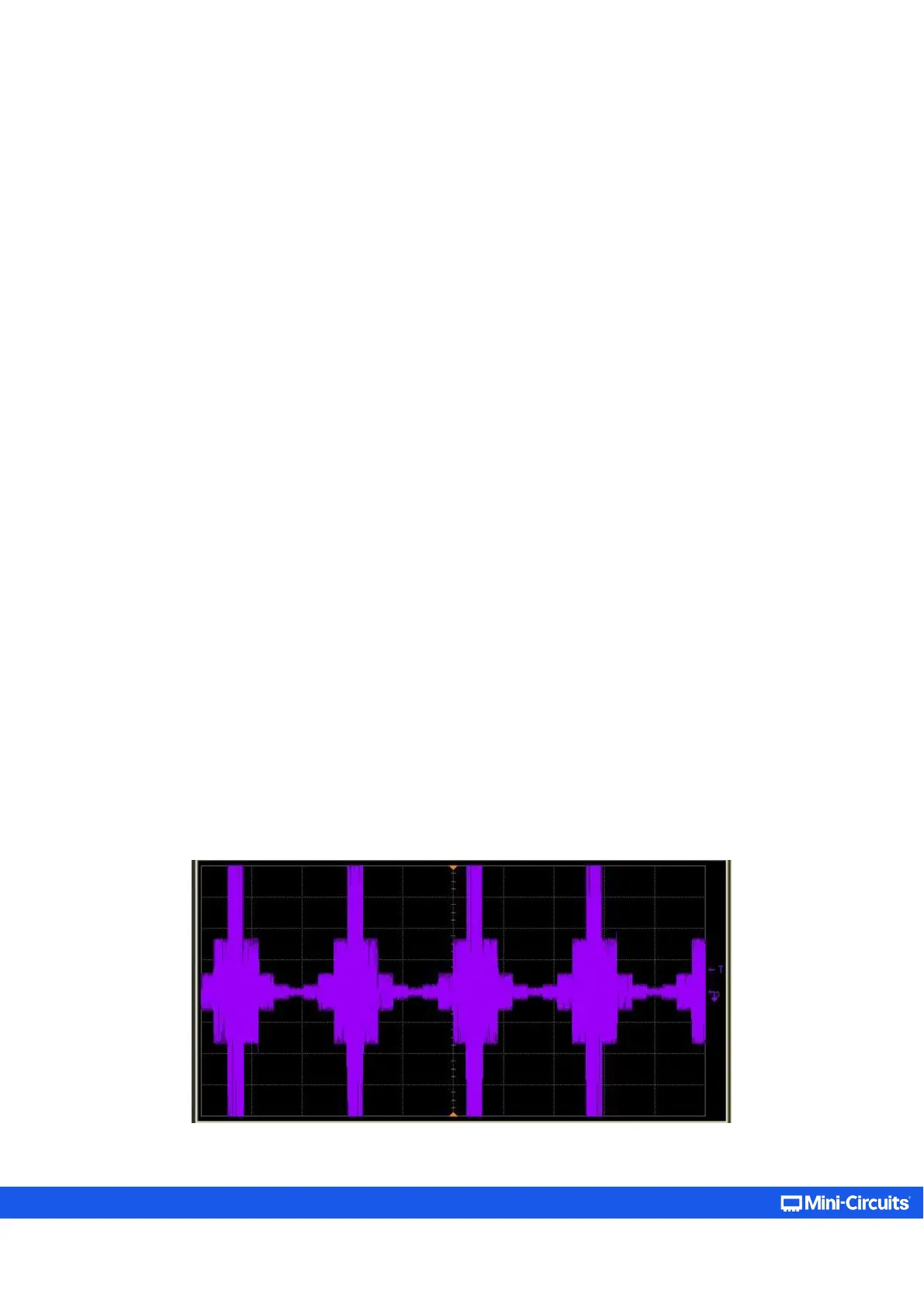
Figure 5.4.4: Plot of signal when sweeping attenuation 0 - 40dB in 10 dB steps (scale 2ms/div)


 To Next Page