Introduction Cha
ter One: General Information
6
In more elaborate systems, the chamber pressure may be controlled with one controller while a
known mass flow is admitted with the aid of a laminar flow element and its separate controller.
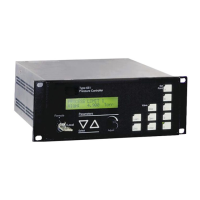
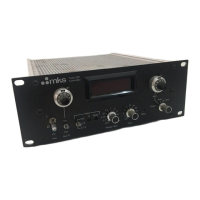
The 250 controller takes the DC pressure signal, compares it to the set point, and positions the
valve so that it drives the actual pressure to the set pressure. The 250 controller contains the
three modes of control action found in most industrial controllers: proportional, derivative, and
integral. Briefly, these functions are as follows:
1.
Proportional
gives a valve action (position) that is instantaneously a linear function of
the error signal. For example:
Signal to valve = K
1
x Error (K
1
is adjustable by the gain pot)
2.
Derivative
action provides a signal to the valve that is proportional to the rate of change
of the error signal. For example:
Signal to valve = K
2
x d Error (K
2
is adjustable by the phase pot)
dt
A simple description of this mode of control is that it provides an anticipation element,
or the valve reaches its proper steady state position sooner than without derivative. This
is apparent when setting up a system; the derivative or phase lead control tailors the
under or overshoot. In other words, it cancels out the build-up of lags already built into
the system.
3.
Integral
action provides an additional valve signal which is proportional to the length of
time that an error signal exists. For example:
Signal to valve =
∫
d Error / dt
In other words, as time passes, the valve position changes which reduces the error signal
to zero.
Note
The 250 controller has the integral and proportional control adjustments
combined into one front panel GAIN pot.


 To Next Page