IP67 IO-Link Modules for EtherNet/IP
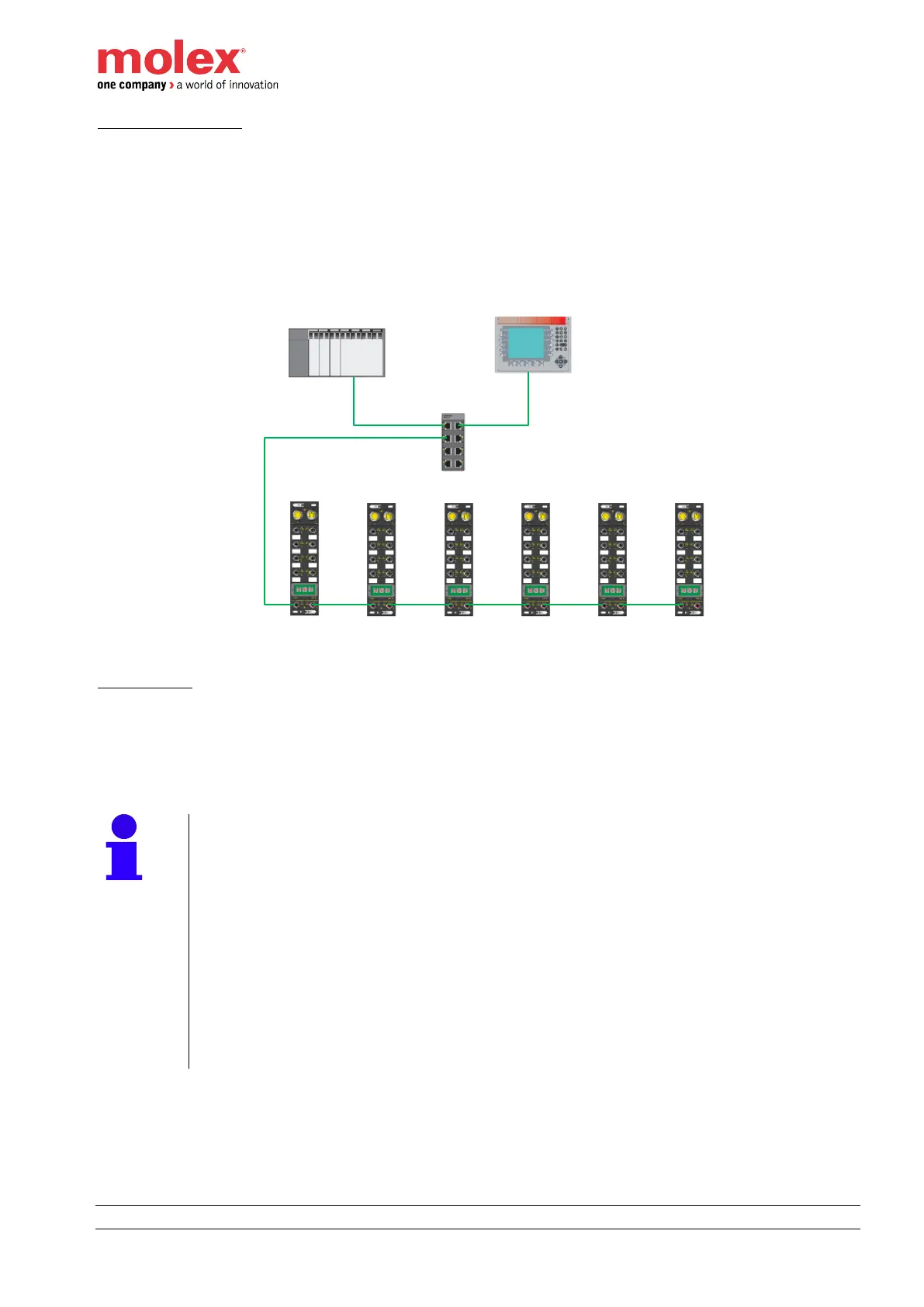
Daisy-chain topology
The daisy-chain topology allows you to connect I/O modules or additional equipment in one line, from one
device to the next in an optimized way along the production line.
When considering the daisy chain topology, note that
• If a module, somewhere in the middle of the chain, has the network cable disconnected or power to the
module is removed then communications to any module located down the chain will be lost.
• The embedded dual port Ethernet switch located in each module eliminates the need for additional
Ethernet switches.
Ring topology
Ring topology allows you to include mixed HarshIO modules and additional devices in a ring. Performing
maintenance on one module – for example, by removing the network cable, or by removing a module – does
not affect other modules as the disruption can be detected and the EtherNet/IP communication can be then
routed adequately. To manage the ring, a specific protocol called DLR (Device Level Ring) is required.
Note!
When considering DLR ring topology:
• A device called ring Supervisor shall be present in the ring to control the
administration and detects the network failures. The other participants are
called DLR Ring Node Announce or Beacon-based.
• Multiple DLR ring Supervisors can be inserted in the ring to improve the
media reliability.
• DLR protocol is a single fault tolerant mechanism. When a failure is
detected, body operations must be performed as soon as possible to
recover the fault.
• HarshIO modules are DLR Ring Node Beacon-based.


 To Next Page