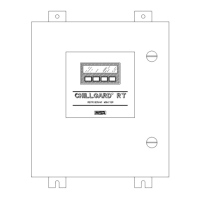
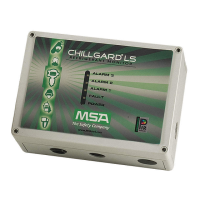
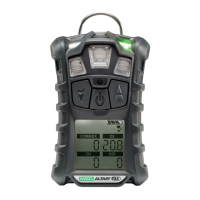
Chemgard Infrared Gas Monitor
Section 2, Installation and Setup
Remote Reset
The audible alarm and latched gas level alarms
can be remotely reset through a switch that has a
momentary contact opening (normally closed set
of contacts). Connections are made to terminal
strip J16, terminals 1 and 2 with the wiring
entering the enclosure through the hole on the
left side of the instrument. The switch must have
signal-level contacts, typically gold plated. The
maximum distance from the reset switch to the
monitor, using 18 AWG wire, is 250 feet
(76 m). The maximum wire size that these
connectors can accept is #12 AWG.
Audible Alarm Output
An output is provided to drive the piezo-electric horn
on the bottom of the unit (FIGURE 1-5). This output
is available for customer use, provided that the
beacon is not installed.
Auxiliary Input - Use UL Listed Devices
A 4-20 mA analog input can be made to the
monitor from another device such as another
Infrared Gas Monitor or an oxygen monitor. The
input wiring should be brought into the enclosure
through the hole on the left side of
the instrument
and connected to terminals 3 (AUX) and 4 (GND)
on terminal strip J16. It is recommended that
Listed #18 AWG, twisted pair wire be used;
maximum wire length is 250 feet (76 m). The
maximum wire size that these connectors can
accept is Listed #12 AWG. Shielded wire is
necessary. Ground the shields of all cables at the
transmitting end of the signal. Do not ground or
connect the shield at the Chemgard Monitor.
CAUTION
All field wiring must be done in accordance
with national and local electrical codes.
Initial Calibration
WARNING
Calibrate after installation; otherwise, false
or erroneous readings can result.
The initial calibration is the same as the routine
calibration. Refer to Section 4 for this procedure.
Multipoint Sequencer
Operation
In the sequencer setup screens, unneeded points
can be de-activated by using the RIGHT ARROW
key and selecting the point to be de-activated.
•
When the change key is pressed, the number
in the display goes blank.
•
After pressing OK, the display shows a dark
diamond to indicate which points are
de-activated (see FIGURE 3-11).
In the sequencer setup screens, the monitor can
be locked on a single point by pressing CHANGE
before the RIGHT ARROW key.
•
After pressing the RIGHT ARROW key and
OK, only the selected point is indicated.
•
After an hour (if no buttons are pushed),
the monitor returns to normal sequencer
operation (see FIGURE 3-12).
When calibrating:
•
the gas inlet point can be selected.
•
an inactive point can be selected.
After leaving calibration:
•
the monitor returns to the previous sequencer
setup (see FIGURE 3-4).
Chemgard operation with a sequencer has a
normal dwell time of 30 seconds per sample line,
or three measurement cycles.
To improve monitor performance in noisy
environments and eliminate false alarms due to
high noise, a user-selectable parameter
"threshold" was established.
•
The factory value for this threshold is 30%.
•
The threshold value is used with the
Caution Alarm setpoint to determine when
additional readings must be made on the
current sample line to confirm actual
concentration at the sample point.
•
The allowable adjustment range for the
threshold value is 30% t
o 70%.
•
If this value is greater or equal to the product
of the threshold and the Caution Alarm value,
the monitor dwells for an additional 70
seconds or seven more measurement cycles.


 To Next Page